
Contractors comparing high-end mini excavators know that a strong engine rating rarely tells the whole story. A machine that looks impressive on a spec sheet can still struggle to clear a side gate, respond smoothly beside a foundation, or keep an operator sharp through a hot afternoon of trenching. On professional construction, landscaping, and utility jobs, the features that decide daily performance often sit well beyond the horsepower figure.
The TYPHON KUVUO Series brings several of those features together in one compact platform. The KUVUO 2.7 pairs a variable-displacement axial piston pump with full pilot joystick controls. It also offers a retractable undercarriage, a Kubota D1105 diesel engine, an enclosed cab with air conditioning and heating, and independent boom swing. Each feature answers a practical challenge that crews face on residential, commercial, and utility sites, from tight access to repeated precision work near structures.
Understanding how these features work, and where their limits are, helps buyers make a confident, well-informed comparison. This guide covers the KUVUO 2.7’s hydraulic design, its access capability, and its engine. It also explains how the operator environment, boom design, and long-term ownership factors fit together, so you can judge the machine against the work you actually perform.
Hydraulic Engineering Beyond Engine Power
Engine horsepower describes how much power the machine can produce. It doesn’t describe how that power reaches the boom, arm, bucket, swing mechanism, or a hydraulic attachment. That job belongs to the hydraulic system, and its design has a direct effect on how the machine feels and performs at the controls.
The KUVUO 2.7 uses a variable-displacement axial piston pump. This pump can adjust how much fluid it delivers per revolution, according to system demand and its control arrangement. A fixed-displacement pump moves the same volume with every revolution. A variable-displacement design can respond as the workload shifts between breakout, lifting, swinging, and fine positioning during a single dig cycle.
In a mini excavator buyer guide, that response matters on real job sites. Excavation work rarely places a constant load on the hydraulics, and demand rises and falls with every pass. A pump that can follow those changes supports controlled delivery to the working functions. The final result still depends on the full hydraulic system, including valves, circuits, controls, and fluid condition, working together as designed.
Pump architecture is a meaningful point of distinction when you compare compact excavators in a similar class. Ask each manufacturer what pump type it uses, how flow is controlled, and what flow and pressure are available for attachment circuits. Those answers reveal far more about working capability than an engine rating viewed on its own.
Key takeaway: The KUVUO 2.7’s variable-displacement axial piston pump gives it a clear hydraulic distinction, so compare pump design, flow control, and attachment output rather than relying on horsepower alone.
Retractable Tracks for Restricted Access
On many residential and commercial jobs, access decides which machine gets the work. A narrow garden gate, a side passage between a house and a fence, or a tight commercial entry can rule out larger equipment before the first bucket of soil moves. A machine that can’t reach the dig area can’t deliver value, however capable it is.
The KUVUO 2.7 addresses this with a retractable undercarriage. It narrows to approximately 39 inches for travel through suitable access points and expands to approximately 51.2 inches for work. Operators get a compact profile on the way in and a wider track stance once they arrive at the excavation area. That combination opens up sites that would otherwise call for hand digging or a much smaller machine.
The wider working stance plays an important role once digging starts. A broader footprint supports steadier digging, swinging, and lifting compared with operating in the narrow setting. Expand the undercarriage to working width wherever the site allows, and follow the manufacturer’s stability requirements before you begin. Width adjustment supports good setup practice but never replaces it.
Planning still matters before mobilizing. Measure every gate, passage, and overhead restriction along the full route rather than assuming the narrow setting will clear. Check ground conditions in the work area, especially near soft fill, saturated soil, or unsupported trench edges. Careful route and site checks protect the machine, the property, and the crew.
Key takeaway: The retractable undercarriage lets the KUVUO 2.7 pass through suitable narrow access points at approximately 39 inches and widen to approximately 51.2 inches for a steadier working stance, as long as operators follow the approved setup procedure.
Evaluating Value Beyond Purchase Price
A high-end mini excavator is a long-term investment, and the purchase price is only the starting point. True value comes from how well the machine performs, how easily it’s maintained, and how closely it matches the work you run most often. These five factors give a clearer picture of ownership value.
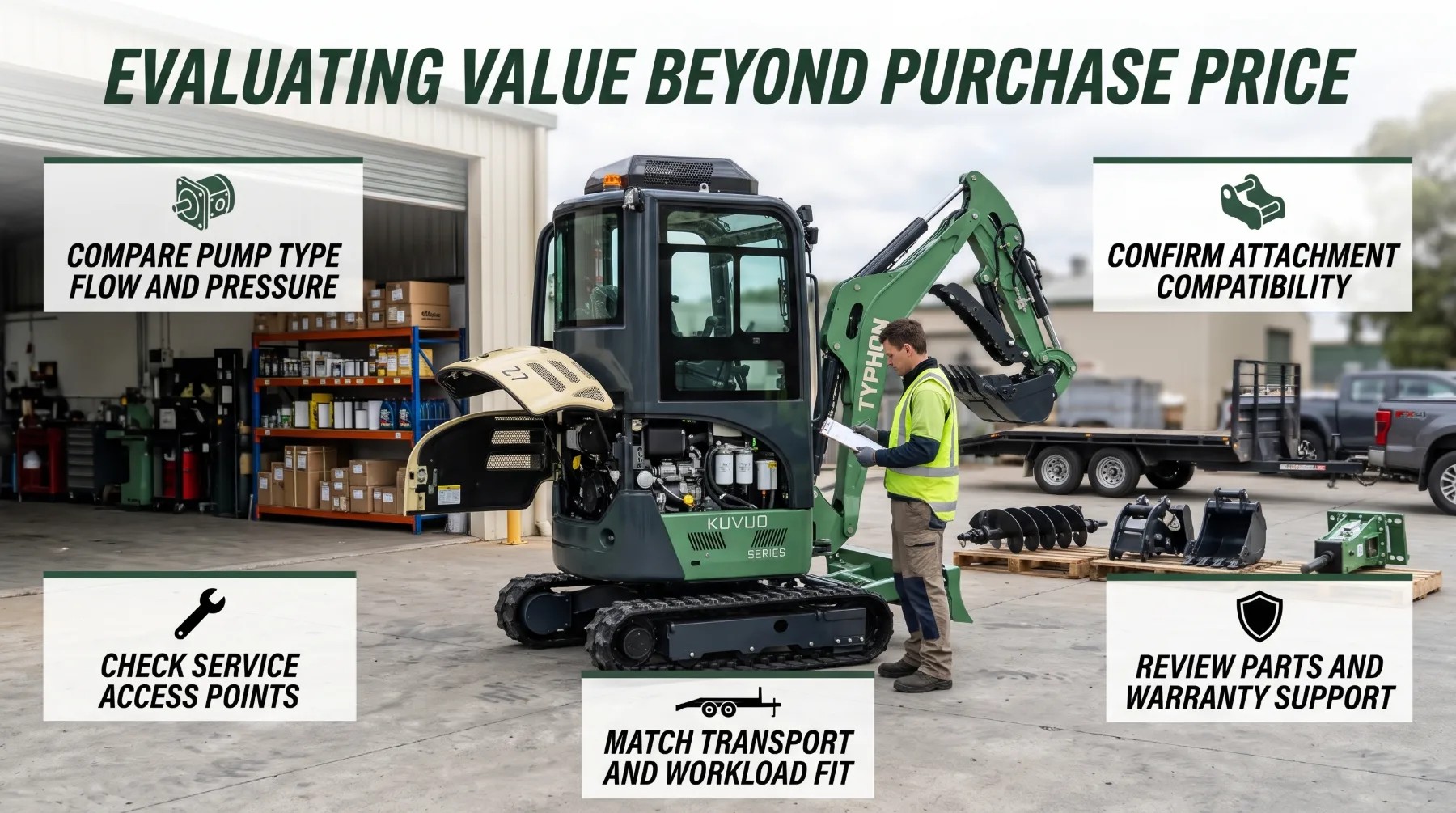
Hydraulic Design: Compare pump type, flow, and pressure to understand how the machine handles digging and attachment work.
Attachment Compatibility: Confirm that augers, thumbs, breakers, and other tools match the machine’s flow, pressure, return line, and coupler setup.
Service Access: Check how easily technicians can reach filters, fluids, and daily inspection points during routine maintenance.
Parts and Warranty Support: Review warranty terms and local parts availability to help keep downtime to a minimum.
Transport and Workload Fit: Match machine weight and dimensions to your trailer, tow vehicle, and most common job types.
Key takeaway: Long-term value comes from hydraulic design, attachment compatibility, service access, parts and warranty support, and workload fit, so weigh all five before comparing purchase price.
Engine Performance for Everyday Excavation
The KUVUO 2.7 uses a Kubota D1105 diesel engine, listed at up to 25 HP in the manufacturer’s product information. Kubota diesel engines are widely used in compact equipment. That familiarity can make routine service, parts sourcing, and technician knowledge easier for many fleets and service providers.
Engine output matters most when the machine has to sustain digging and hydraulic work across a full shift. The engine drives the hydraulic pump, so steady power delivery supports consistent response under load. On a long trenching day or a foundation dig with dense soil, a dependable power source helps the machine keep working at a steady pace.
The horsepower figure still needs context. Two machines with similar engine ratings can perform quite differently depending on their hydraulic design, operating weight, and digging geometry. A higher rating doesn’t automatically mean faster excavation, and a well-matched system can make efficient use of the power it has.
Read the engine specification alongside operating weight, hydraulic flow, system pressure, and working range. Confirm the published figures for the exact model and configuration you’re evaluating. Evaluating the full specification sheet together gives you a far more accurate picture of real capability than any single number.
Key takeaway: The Kubota D1105 diesel provides the power behind the KUVUO 2.7’s hydraulic system, but engine output should always be compared together with weight, hydraulic specifications, and working range.
Boom Design and Working Flexibility
Walls, fences, foundations, and property lines are routine obstacles on residential and commercial sites. Without boom swing, an operator often has to reposition the entire undercarriage to dig alongside them. Each extra move adds time, increases ground disturbance, and can bring the machine closer to structures than necessary.
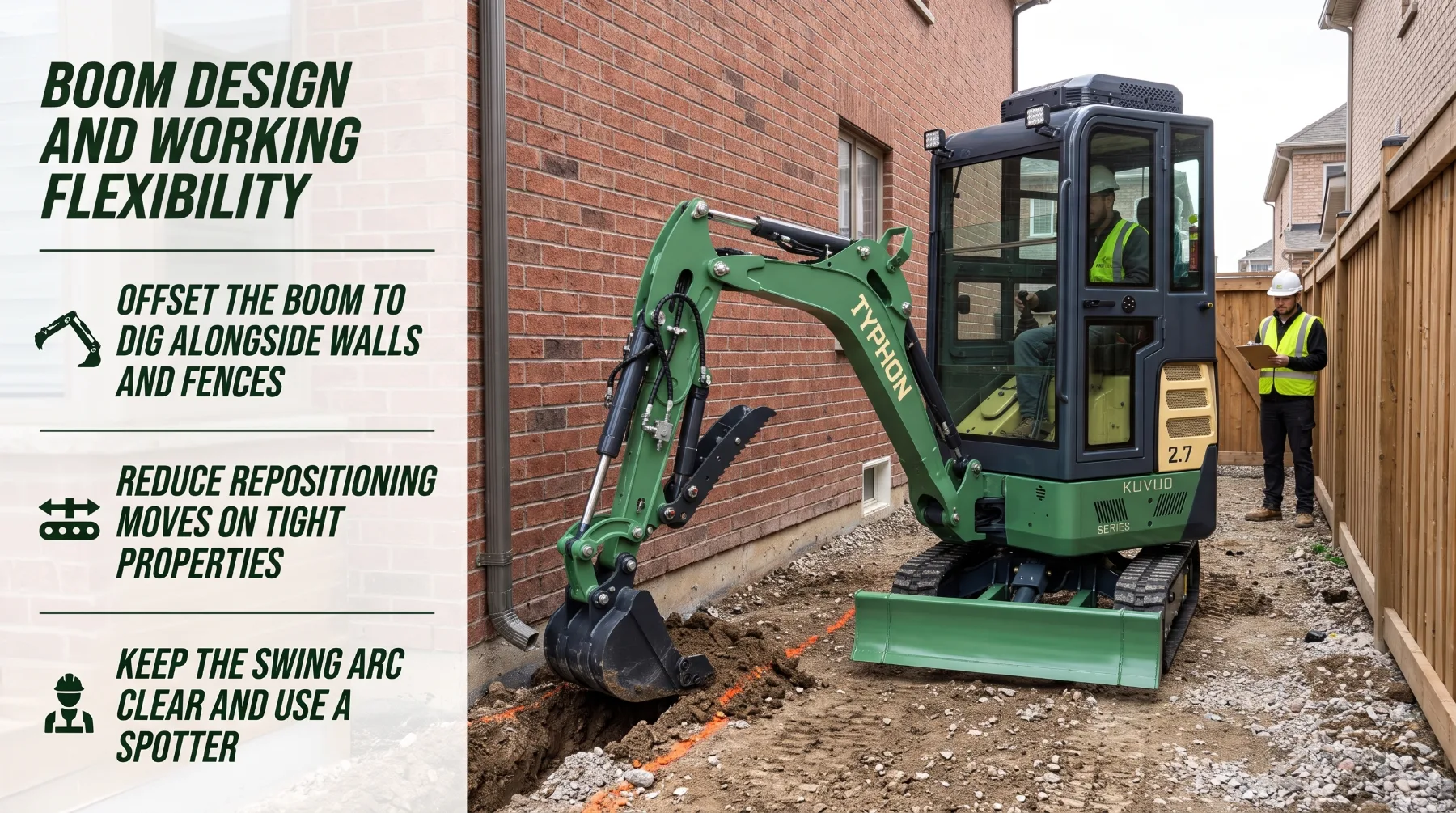
The KUVUO 2.7 product specifications describe independent boom swing. This lets the boom offset to either side of the machine’s centerline while the upper structure and undercarriage stay in position. Operators can cut a trench parallel to a foundation wall or dig beside a fence line while keeping the machine set up on stable ground.
That flexibility suits trenching, foundation work, drainage installation, and utility connections in restricted areas. It also helps when the undercarriage can’t be squared up to the cut because of site layout or surrounding features. Fewer repositioning moves can mean cleaner work, less surface damage, and a more efficient day on tight properties.
Actual reach and working clearance depend on machine position, ground conditions, and the surrounding site. Plan the setup so the swing arc and boom stay clear of walls, fixtures, and overhead obstacles. Use a trained spotter whenever part of the working envelope is out of the operator’s view, and keep people clear of the swing area at all times.
Key takeaway: Independent boom swing helps the KUVUO 2.7 dig alongside walls, fences, and foundations with fewer repositioning moves, provided the setup keeps the boom and swing arc clear of structures.
Operator Comfort for Longer Workdays
Operator condition has a direct effect on output, precision, and safety. Heat, cold, dust, and noise wear operators down over a long shift, especially during repetitive trenching, grading, or cleanup work. A tired operator works more slowly and with less accuracy, and that cost adds up across a busy season.
The KUVUO 2.7 features an enclosed cab with air conditioning and heating. Climate control helps operators keep working through summer heat, cold mornings, and dusty site conditions without the constant distraction of discomfort. The enclosed cab also gives the operator a more controlled space to focus on the bucket, the cut, and the people working nearby.
Pilot joystick controls add to that operator environment. They use low-pressure pilot signals to command machine functions, which supports smooth, proportional input with low physical effort. When the bucket is working close to a foundation, fence, or marked utility line, light and precise inputs help operators feather each movement rather than jerking the boom into position.
Comfort and control are best judged in person. During a demonstration, check seat adjustment, sightlines to the bucket and tracks, and how naturally each control falls to hand. Note how easily operators can enter and exit the cab, and how quickly a new operator becomes confident with the layout. These details shape how the machine feels at hour eight, not just minute five.
Key takeaway: An enclosed cab with air conditioning, heating, and pilot joystick controls helps operators stay comfortable and precise through long shifts, while seat, visibility, and entry should be confirmed during a demonstration.
Conclusion
The TYPHON KUVUO Series stands out because its features work together to solve real job-site challenges: a variable-displacement axial piston pump shapes how power reaches the boom, arm, bucket, and attachments, a retractable undercarriage narrows to approximately 39 inches for suitable access points and widens to approximately 51.2 inches for a steadier working stance, a Kubota D1105 diesel engine listed at up to 25 HP drives sustained hydraulic work across a full shift, an enclosed cab with air conditioning, heating, and pilot joystick controls keeps operators comfortable and precise, independent boom swing helps crews dig beside walls and fences with fewer repositioning moves, and a value assessment built on hydraulic design, attachment fit, service access, parts and warranty support, and workload match reveals the machine’s true ownership cost. Before you commit, list the jobs you run most often, measure the gates and passages on your typical sites, confirm the flow and coupler requirements of every attachment you use, check your trailer and tow vehicle ratings, review local parts and warranty coverage, and schedule a demonstration on representative ground so you can judge visibility, control response, and working range against your actual workload.
Frequently Asked Questions
What makes the KUVUO Series different from a basic mini excavator?
The KUVUO 2.7 combines a variable-displacement axial piston pump, a retractable undercarriage, full pilot joystick controls, independent boom swing, and an enclosed cab with air conditioning and heating. Together, these features address hydraulic response, restricted access, precision near structures, and operator comfort. Many basic machines offer only some of these features.
Why are retractable tracks useful on a mini excavator?
Retractable tracks narrow the machine for travel through suitable gates and passages, then expand for a wider working stance. On the KUVUO 2.7, the undercarriage adjusts from approximately 39 inches to approximately 51.2 inches. Operators should still expand the tracks where the site allows and follow the manufacturer’s stability requirements before digging or lifting.
Does higher engine horsepower guarantee better digging performance?
No. Hydraulic design, pump capacity, flow, pressure, operating weight, and digging geometry all influence performance. Attachment compatibility, ground conditions, and operator technique matter as well, so compare the complete machine specification rather than horsepower alone.
What should buyers compare before purchasing a high-end mini excavator?
Compare working range, hydraulic specifications, access dimensions, operator environment, and attachment compatibility. Also review service access, parts availability, warranty terms, transport requirements, and total ownership costs. A demonstration on ground similar to your typical sites helps confirm the machine suits your work.
americanminiexcavator.com Featured Equipment
Looking for top-performing heavy equipment, authentic attachments, and dependable jobsite power? Explore verified models backed by manufacturer warranty and nationwide delivery.