
How Platform Load Affects Electric Scissor Lift Battery Life
 An electric scissor lift shows a full battery gauge at the start of every shift, but that reading tells only part of the story. How long the charge actually lasts depends heavily on the mass sitting on the deck. As payload climbs, the drive system must pull harder to hoist the combined weight of the platform, workers, tools, and stock. That extra effort translates straight into current pulled from the pack, and higher current empties stored energy sooner. Operators who plan around the gauge alone, without accounting for weight, often find themselves recharging far earlier than expected. Payload discipline therefore shapes daily uptime as much as it shapes safe handling. When you keep the deck within its rated figure, the motor, controller, and cells all operate inside their intended envelope, and the pack delivers closer to its published working hours. Overburden the platform, or spread the weight unevenly, and you speed up energy consumption, add thermal strain to the cells, and cut short the hours you get between charges. Sizing the real payload against the machine’s rating, and grasping how mass drives current demand, keeps run time steadier from clock-in to clock-out.
How the Battery Powers the Lifting Motor
An electric scissor lift stores its energy in a rechargeable pack, usually a bank of lead-acid or lithium cells wired to feed a DC or AC drive motor. That motor spins the hydraulic pump, and the pump sends fluid to the cylinders that spread the arms and raise the deck. Every function you trigger, from raising to driving, taps the same reservoir of stored charge. Two things govern how quickly that reservoir empties: how much current the motor pulls and how long it pulls it. Voltage stays roughly fixed, so the current draw during each raise, multiplied by its duration, decides the energy spent. A light deck asks for a modest pull over a brief rise. A near-limit deck asks for a heavy pull over a longer one. Key takeaway: The pack feeds every lifting function through the drive motor, so whatever raises the current the motor pulls will empty stored charge sooner.
Why a Heavier Deck Raises Current Demand
Mass on the platform is what the motor must overcome. With a sparse deck, the pump meets little back-pressure, the motor spins with ease, and the amperage stays low. Pile on stock and gear, and the cylinders shove against far greater resistance, forcing the motor to summon more torque, which it can only do by pulling more amperage from the cells. That surge in amperage carries a second cost beyond raw energy. Pushing high current through the pack and windings generates heat, and warmth is corrosive to cell chemistry over months of use. A single loaded rise won’t harm anything, but shift after shift of peak-current lifting quietly accelerates capacity fade, trimming both the hours per charge and the total charges the pack will ever accept. What this means for you: A gauge that plummets under a fully stocked deck isn’t a defect. The cells are simply surrendering charge at the faster rate that heavy lifting demands. Key takeaway: A heavier deck compels the motor to draw more amperage, which spends charge quicker and produces heat that erodes cell health over time.
Rated Payload and Charge Endurance
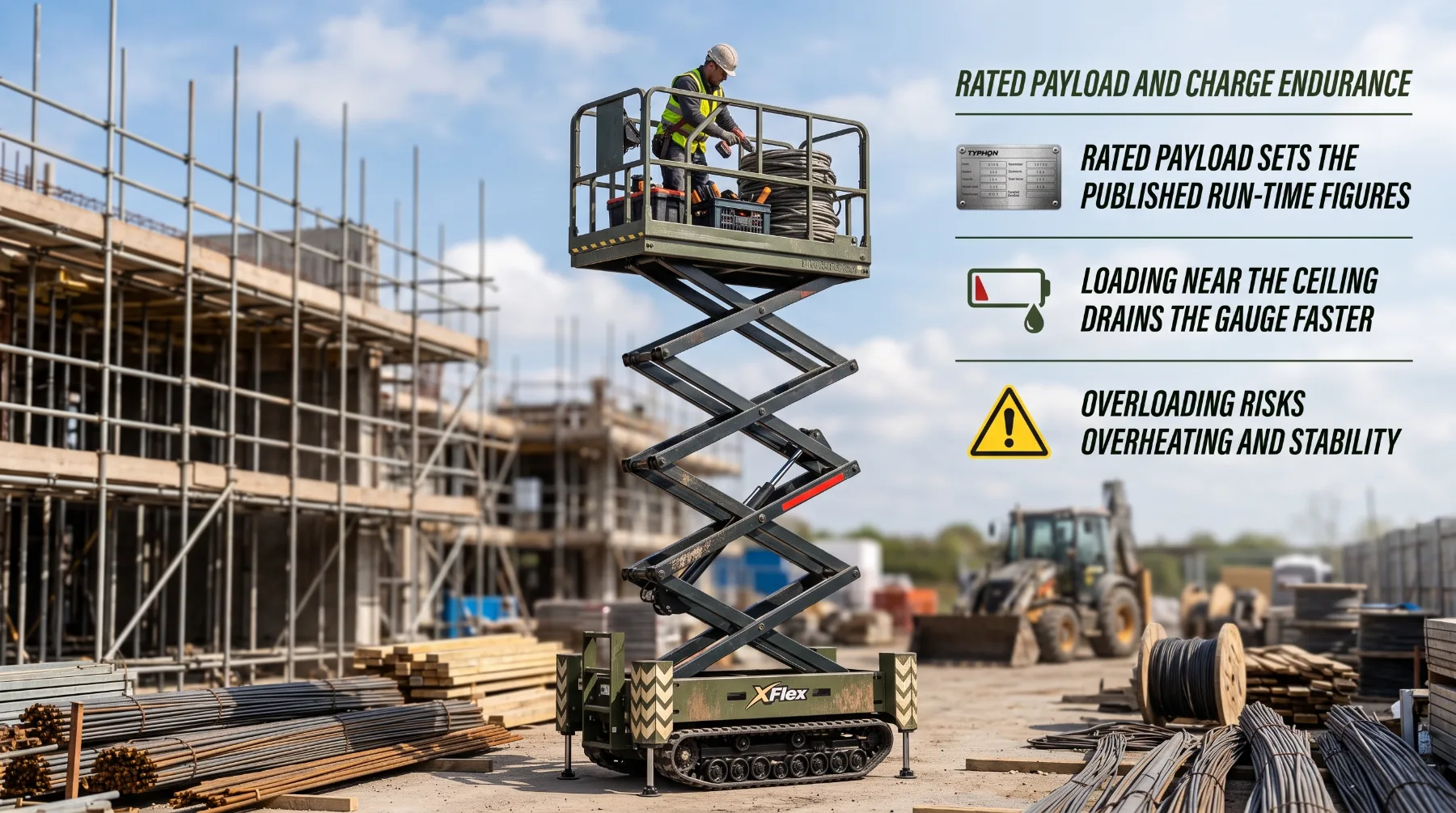 Every electric scissor lift lists a rated payload, the top weight the deck is built to elevate safely. Manufacturers also publish run-time and cycle estimates, and those figures assume the machine works at or below that rating. Load toward the ceiling on every rise, and the gauge will fall noticeably faster than it does with a bare or lightly stocked platform. Respecting the rated figure keeps endurance and safety predictable together. Crowding past it wins you nothing on run time; instead you drain the pack harder, overheat the windings, and court a stability hazard. Overburdening is never a workaround for a tight schedule.
Why the Rating Doubles as an Endurance Guide
The payload number marks more than a safety boundary. It also flags the zone where the drive system sips energy at the rate the engineers intended. Stock the deck sensibly beneath it, and the pack holds its hours. Ride the ceiling all day, and you’ll watch the charge bleed away long before the shift ends. Key takeaway: The rated payload sets both the safe working zone and the conditions behind published run-time figures, so staying under it keeps charge endurance dependable.
How Cycle Count Falls as Load Climbs
A charged pack holds a set quantity of energy. When each rise costs more of it, the arithmetic is simple: you complete fewer lifts before the cells run flat. Cycle count, not just elapsed hours, frequently decides whether a crew wraps the task or breaks to plug in. Picture a rough example. Suppose a full charge carries a machine through roughly 100 rises with a sparse deck. Stock that same lift close to its rating, and the count may slide to 60 or 70 rises. Nothing has broken and the pack hasn’t degraded; the heavier duty is simply drawing down the charge at a steeper pace. For teams that raise and lower repeatedly through the day, that shortfall separates an uninterrupted shift from a stall. In practice: Fold cycle count into your scheduling. Once you know a loaded deck trims the rises per charge, you can order the work so the pack lasts through the priority tasks. Key takeaway: Because each loaded rise costs more energy, climbing payload directly shrinks the number of lifts per charge, which often triggers the mid-shift plug-in.
How Load Trims Run Time and Spreads Across the Site
Payload also dictates total run time, the span the machine stays useful before the pack needs replenishing. A heavier deck narrows that span, and a narrow span sets off consequences that reach well past the single lift.
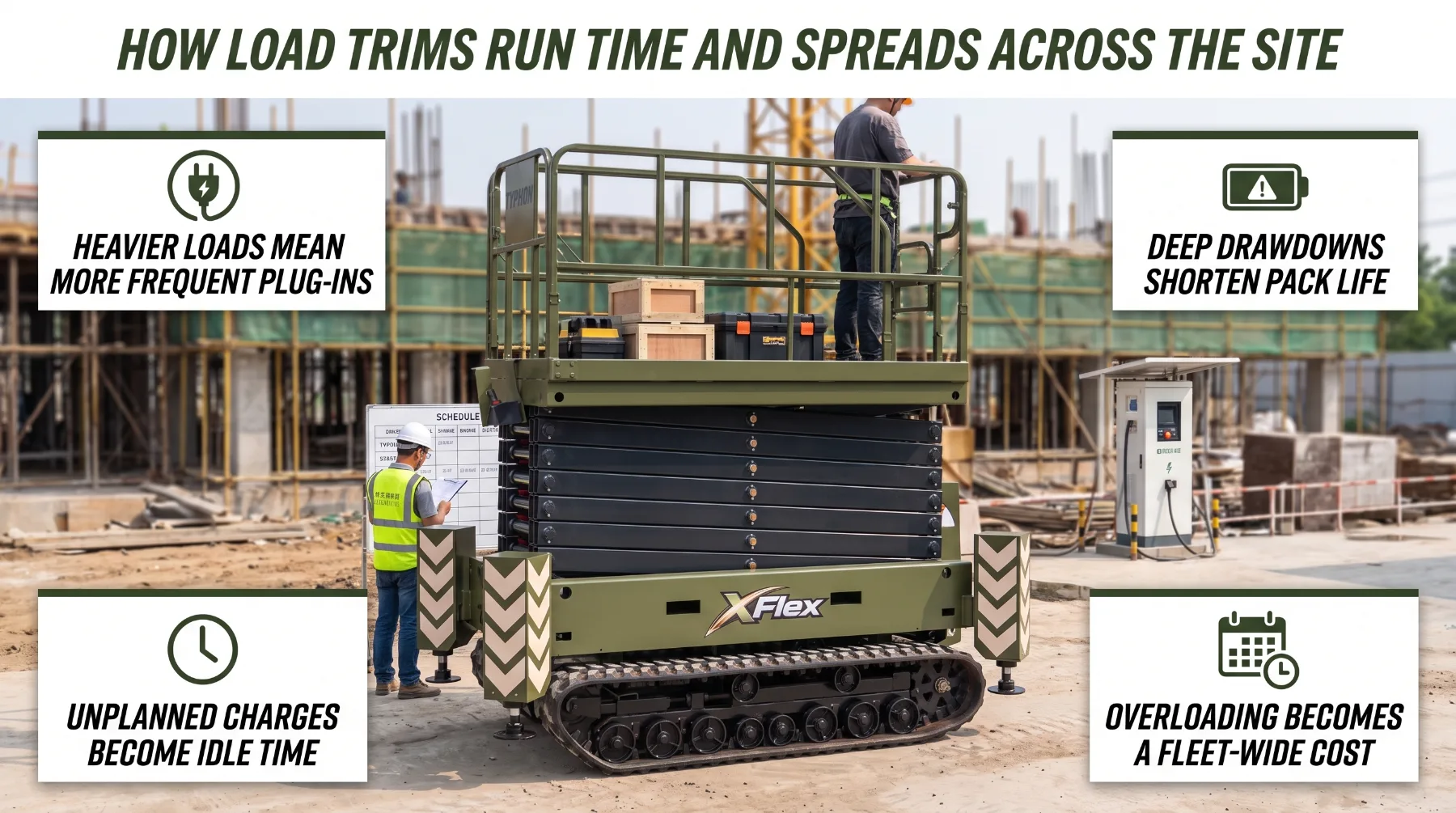 More frequent plug-ins break the rhythm of the work and occupy chargers that other units may be waiting on. Deeper drawdowns, which heavy duty encourages, tax the cells and can trim the pack’s service life. And each unplanned recharge is idle time that stacks up over a week or a full contract. A deck loaded past what the task requires quietly mutates into a scheduling snag, a fleet-availability snag, and a long-run replacement-cost snag all at once. Key takeaway: A heavier deck shortens run time, which multiplies plug-ins, deepens drawdowns, and drains productivity across the whole site.
Conclusion
Payload and battery endurance are bound together through the drive system, because adding mass to the platform raises the torque the motor must produce, which in turn raises the current it pulls from the pack and the energy each rise consumes. For a fixed cell capacity and motor rating, greater current demand shortens both the run time available on a charge and the number of lift cycles achievable before recharging, so endurance should be assessed under representative loads rather than treated as a single headline figure. The true relationship hinges on pack capacity and chemistry, motor and controller efficiency, hydraulic losses, ambient temperature, and the depth of discharge across repeated cycles, all of which interact over the working day. Operating near the rated payload elevates current draw and thermal loading in the cells, windings, and controller, accelerating capacity fade and shortening service life over time. Machine selection should therefore weigh rated platform capacity, working height, run-time and cycle claims under load, pack capacity and chemistry, charging profile and downtime, duty cycle, and the typical payload the job demands. Efficient operation further calls for hoisting only the necessary personnel, tools, and stock, avoiding needless rises, charging within the manufacturer’s guidance, and maintaining the motor, terminals, connectors, and cells in sound condition. Matching pack capacity and drive performance to the expected workload lets an electric scissor lift hold consistent run time, control cell strain, and support dependable service across its life.
Frequently Asked Questions
Why does my electric scissor lift’s battery drain faster on some days than others?
Payload is usually one of the biggest factors. A heavier combination of workers, tools, and materials requires more current from the battery during each lift, so working near the rated payload can shorten runtime significantly compared with lighter work. Frequent raising and lowering compounds the effect because every lift consumes energy. Temperature, charging habits, travel distance, and surface conditions also contribute, but payload and lift-cycle frequency often create the largest day-to-day difference. If runtime changes noticeably, first look at how heavy the loads were and how often the platform was raised.
Does regularly working near the rated payload harm the battery over time?
It can shorten battery life over time, although a single shift will not normally damage the pack. Operating near the rated payload increases current demand from the lift motor and can generate more heat in the motor and battery. Repeated heavy use combined with deep discharges adds further stress and can gradually reduce the battery’s available capacity. Keeping some margin below the rated payload, avoiding frequent deep drawdowns, and allowing the machine to cool in hot conditions can reduce stress and help preserve battery performance over more charging cycles.
How can I squeeze more lift cycles out of one charge?
Start by carrying only the load needed for each task, since reducing platform weight lowers the energy required for every lift. Combine tasks when practical so you can complete more work per cycle instead of repeatedly raising and lowering the platform. Keep loads balanced and stay comfortably below the rated payload to reduce current demand. Follow the manufacturer’s charging recommendations and avoid frequent deep discharges, which can shorten battery life. Regularly maintain the lift motor and keep battery terminals clean and secure, since efficient electrical and drive components can reduce energy losses and help maximize usable lift cycles from each charge.