


Why Does a Road Roller Leave Uneven Compaction? Common Mistakes Contractors Make

A grading contractor finishes a driveway base, watches the road roller cross it a few times, and signs off on ground that looks flat and solid under the afternoon sun. Weeks later the homeowner calls about ruts forming near the garage, a soft strip running down one edge, and hairline cracks spreading across the fresh asphalt laid on top. The roller worked, the mix was right, and the base looked done, yet the surface failed anyway because the compaction underneath was uneven in ways nobody could see from the seat. Patching it costs three times what proper rolling would have, and the contractor's name rides on the repair. That hidden failure is exactly why understanding uneven compaction matters before the drum ever touches the ground.
Uneven compaction rarely announces itself. Most of the time a surface looks finished right up until soft spots, ruts, and cracks reveal that density varied across the site. Nearly every case traces back to a handful of avoidable habits, not a faulty machine.
This guide breaks down six mistakes that leave a surface unevenly compacted and shows how to correct each one. Here's what you'll walk away knowing:
- Where coverage gaps and rushed passes quietly weaken a surface
- How speed, lift thickness, and moisture throw density off
- Why grades, turns, and skipped testing hide problems until it's too late
Read the mistakes below, and you'll spot the causes before they cost you a callback.
Leaving Gaps Between Passes
Coverage is where uneven compaction starts most often, and the culprit is a drum that doesn't lap the strip beside it. When an operator runs each pass edge-to-edge instead of overlapping the previous track, a thin seam between passes receives far fewer strikes than the ground on either side. That seam stays porous and weak while the surface around it reaches full density, so the surface looks uniform even though it isn't.
Overlapping every pass by several inches, ideally four to six, closes those seams and gives the whole width the same treatment. Picture the drum tracks as roof shingles: each one should cover the edge of the last so no gap slips through. Rolling in straight, planned lanes rather than wandering across the mat keeps that overlap consistent from one end to the other.
Edges deserve the same attention as the middle. Skipping the outer few inches leaves a soft shoulder that ravels and crumbles first under traffic, so working the edges deliberately protects the surface where it fails soonest.
Key takeaway: Lap each pass over the last by four to six inches, roll in straight lanes, and never neglect the edges. Even overlap is the single fastest way to erase the seams that cause uneven compaction.
Rolling Too Fast to Build Density
Speed quietly wrecks density more than most operators realize, since a drum moving too quickly can't transfer its full force into the material. Each spot needs a moment under the drum to compact, and racing across a mat shortchanges every square foot, leaving density that varies with how steady the operator holds his pace. Fast in one stretch and slow in another produces exactly the patchy result you're trying to avoid.
Holding a slow, consistent speed lets the drum deliver even compaction across the whole surface. Most manufacturers recommend a walking-pace roll, roughly 2 to 4 miles per hour depending on the material, and staying within that range matters more than finishing a minute sooner. Vibration compounds the problem when speed runs high, because a fast-moving vibratory drum spaces its impacts too far apart, leaving washboard-like ripples of alternating dense and loose material.
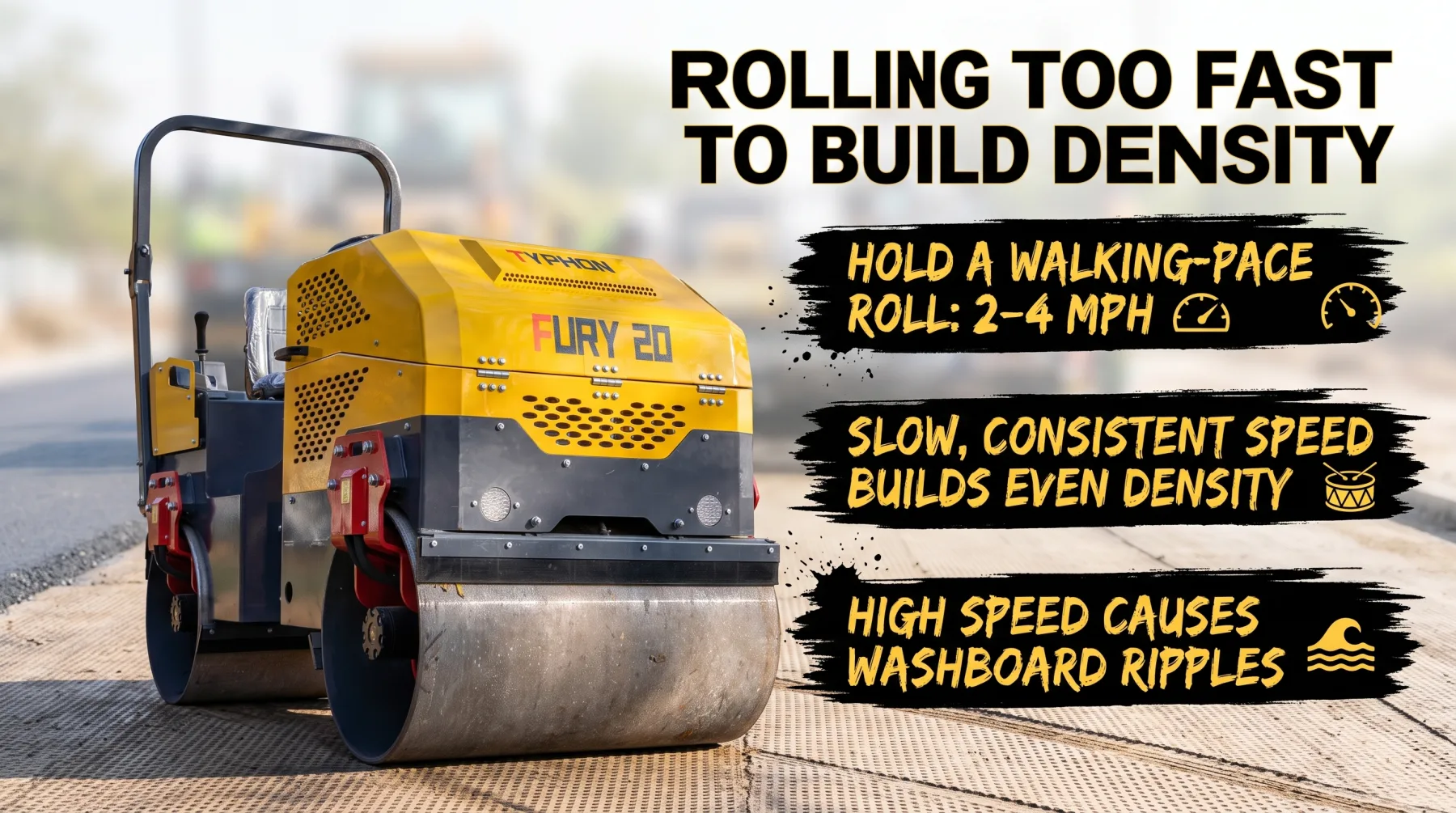
Consistency beats hurry every time here. A section rolled at one steady speed compacts uniformly, while the same section rushed and then slowed builds density that swings from spot to spot.
What this means: Keep the roller at a slow, even walking pace and resist the urge to rush. Steady speed spreads the drum's force evenly, and consistency across every pass is what delivers uniform density.
Building Lifts the Wrong Thickness
Lift thickness decides whether compaction reaches all the way down or only skins the surface, and getting it wrong leaves density uneven from top to bottom. Spread a lift too thick, and the drum's energy compacts the upper few inches while the material underneath stays loose, creating a hard shell over a soft core that fails once loaded. Layer it too thin, on the other hand, and you waste passes while risking crushed aggregate near the surface.
Matching lift depth to the roller's capability keeps compaction uniform through the full layer. As a rule, granular base compacts well in lifts of six to eight inches for a properly sized roller, though the right number shifts with machine weight and vibration. Splitting a deep fill into several thinner lifts, compacting each before spreading the next, guarantees density from the bottom up rather than trapping loose material below a firm crust.
Uniform spreading matters as much as total depth. A lift that runs thick in one area and thin in another compacts unevenly no matter how well you roll it, so grading the material to a consistent thickness before rolling sets the stage for even density.
Key takeaway: Spread lifts to a consistent depth the roller can fully compact, usually six to eight inches for granular base, and split deep fills into layers. Even lift thickness is what lets density reach uniformly from bottom to top.
Ignoring the Moisture in Your Material
Moisture governs how well soil and asphalt compact, and a material that's too wet or too dry resists density no matter how many passes you make. Soil compacts best at its optimum moisture content, where water lubricates the particles just enough to pack them tight. Too dry and the particles won't slide together; too wet and trapped water keeps them apart, creating a spongy, pumping surface. Understanding how road roller weight affects compaction quality and productivity is also essential, because the right machine weight helps deliver the pressure needed to achieve proper density without wasting time on unnecessary passes. Since moisture varies across a site, one section can hit density easily while another stays stubbornly soft under the same rolling conditions.
Checking moisture before you roll heads off the problem that no amount of extra passes will fix. On soil, a quick field check or a lab-confirmed optimum tells you whether to wet the material down or let it dry before compacting. Asphalt runs on temperature rather than water, but the principle holds: a mat rolled while it stays within its compaction temperature window reaches density evenly, while a mat that cools unevenly compacts hard in the warm spots and poorly in the cold ones.
Timing ties directly to moisture and temperature. Rolling promptly on asphalt before it cools, and compacting soil while it sits at optimum, keeps density even across the whole surface instead of varying with conditions.
What this means: Confirm soil sits at optimum moisture and asphalt stays in its temperature window before you roll. Get the moisture and timing right, and the material compacts evenly instead of leaving soft, wet, or cold spots behind.
Mishandling the Roller on Grades and Turns
Operator technique on slopes and corners creates uneven compaction that a perfect rolling plan can't prevent. Turning the drum sharply while it sits on fresh material shoves and tears the surface, gouging some spots and leaving others loose, so making wide, gradual turns off the compacted area protects the density you've built. Sharp pivots concentrate stress in one place and undo the uniform coverage the passes were meant to create.
Grades demand a deliberate approach that flat ground never requires. Rolling straight up and down a slope rather than across it keeps the drum's weight distributed evenly, since angling across a grade shifts force to the downhill edge and compacts one side harder than the other. Starting at the lower edge and working uphill also helps the roller hold a consistent line instead of drifting sideways on the incline.
Stops and starts leave their own marks when handled carelessly. Halting the drum abruptly on a hot asphalt mat presses a dip into the surface, so easing to a stop and staggering where you reverse spreads those marks out instead of stacking them in one line.
Key takeaway: Turn wide and gently off the fresh material, roll straight up and down grades rather than across them, and ease into stops. Careful technique on slopes and corners keeps density even where sloppy handling would gouge and vary it.
Skipping the Density Check
Testing is the step that separates a surface you know is uniform from one you only hope is, and skipping it lets uneven compaction slide by unnoticed. Eyeballing a flat, finished-looking surface tells you nothing about the density hiding underneath, so a section that looks identical to its neighbor can carry a soft spot no visual check would ever catch. Testing at several points across the site is the only way to confirm density holds steady everywhere, not just where the surface looks good.
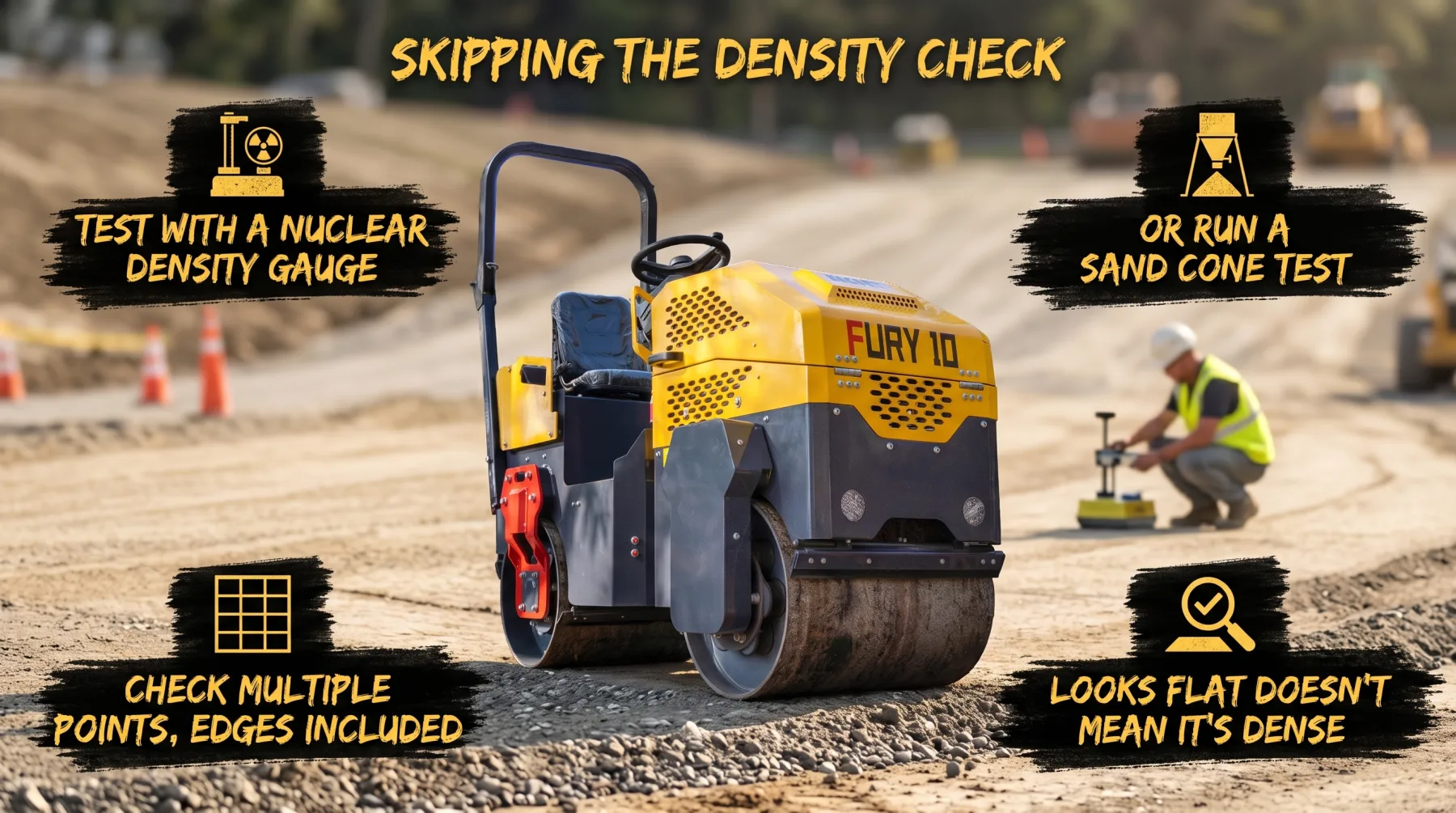
Measuring density at multiple locations exposes the variation a single test would miss. A nuclear density gauge reads compaction fast and non-destructively, while a sand cone test measures it directly, and taking readings across the full area, edges included, reveals whether any zone fell short. Relying on one reading near the center assumes the whole site matches it, which is exactly the assumption uneven compaction defeats.
Proof-rolling offers a practical field check between instrument tests. Watching for movement, rutting, or pumping under a loaded pass flags soft areas on the spot, so a section that flexes while its neighbors hold still gets extra attention before you move on.
What this means: Test density at several points across the whole site rather than trusting how the surface looks. Multiple readings catch the soft spots that uneven compaction hides, and catching them early beats discovering them after the surface fails.
Conclusion
Uneven compaction almost always traces back to habits you can fix, not a machine you can't. Overlap every pass by several inches, hold a slow and steady speed, and spread lifts to a consistent depth the roller can fully compact. Confirm your soil sits at optimum moisture and your asphalt stays in its temperature window, handle grades and turns with deliberate care, and test density at multiple points rather than trusting how the surface looks. Correct these six mistakes, and you build a surface that carries its load and holds its shape for years instead of failing in soft spots and cracks. Start with your next job: walk the rolling plan before the drum moves, check moisture and lift thickness up front, and test the finished density before you sign off. When you're ready to put a dependable road roller matched to your site to work, reach out to a trusted equipment specialist who can pair a reliable machine with the results your projects depend on.
Frequently Asked Questions
Why does my road roller leave soft spots? Soft spots usually come from uneven coverage or moisture problems. If the drum skips overlap between passes, thin seams get fewer strikes and stay loose, while material that's too wet or too dry won't reach density no matter how many passes you make. Rolling too fast and spreading lifts too thick cause the same trouble by leaving the lower material under-compacted. Check your overlap, moisture, speed, and lift thickness, then test density at several points to find the weak areas.
How much should road roller passes overlap? Overlap each pass by roughly four to six inches over the previous drum track. That coverage closes the thin seams between passes that would otherwise stay porous and weak, giving the whole width the same number of strikes. Roll in straight, planned lanes rather than wandering across the surface, and work the outer edges deliberately, since a skipped shoulder ravels and fails first under traffic.
How do I know if compaction is uneven? The surest way is to test density at multiple points across the site with a nuclear gauge or sand cone test, since a flat, finished-looking surface hides the variation underneath. On site, proof-rolling helps too: make a loaded pass and watch for movement, rutting, or pumping, because a section that flexes while its neighbors hold still signals a soft, under-compacted spot. Never rely on how the surface looks alone, as uneven density rarely shows until the surface starts to fail.