
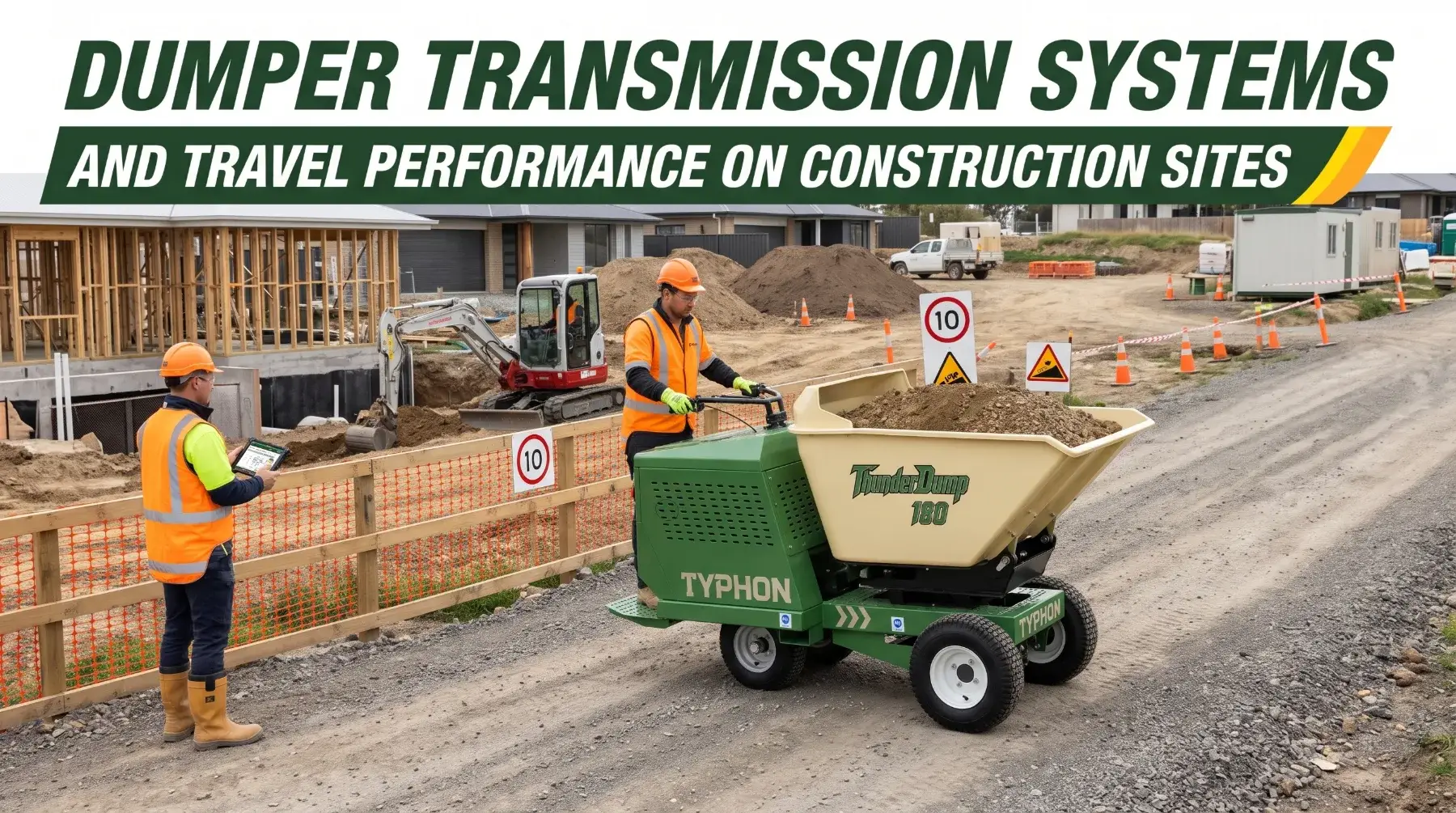
A site dumper spends most of its working day traveling. It climbs out of a foundation dig with a full skip of spoil, crosses a rutted haul road to the stockpile, and creeps along a narrow route beside a trench. Then it reverses back to the excavator and does it all again. Each trip depends on the transmission delivering engine power to the wheels or tracks smoothly, predictably, and with enough control to keep the machine and its load safe.
Transmission design shapes almost everything about how a dumper travels. It decides how the machine pulls away with a heavy load, how it holds speed on a grade, and how it changes direction in tight spaces. It also affects how the dumper slows on a descent and how much attention the operator must give to gear selection instead of the route ahead. A transmission that suits the site keeps cycles steady and operators in control. One that doesn’t lead to wheel spin, slow trips, overheating, and avoidable risk.
How a Dumper Transmission Transfers Engine Power
An engine produces power at a fairly narrow range of speeds, but a dumper needs to move at very different speeds under very different loads. Pulling away uphill with a full skip calls for high torque at the wheels and low speed. Running empty along a firm haul road calls for less torque and more speed. The transmission sits between the engine and the wheels or tracks and bridges that gap.
On most wheeled site dumpers, power flows from the engine through the transmission to a transfer arrangement, then through drive shafts to the front and rear axles. Each axle contains a differential, which lets the wheels on either side turn at different speeds through a turn, and final drives that reduce speed and multiply torque at the hubs. Many dumpers drive all four wheels full time. This four-wheel drive layout is central to traction on loose and uneven ground.
Articulated site dumpers add another element. The chassis pivots at a center hinge for steering, and the rear section often oscillates so all four wheels stay in contact with uneven ground. Drive shafts pass through or near this hinge, which is why the articulation joint and its drive components need regular inspection. Tracked mini dumpers work differently. Their drive usually reaches each track through a hydraulic motor and final drive at the sprocket, with steering produced by varying the speed of each track.
Whatever the layout, the transmission determines how smoothly power arrives, how precisely the operator controls speed, and how the machine behaves when the operator lifts off the pedal. Review the manufacturer’s transmission specifications, gear or speed ranges, and operating instructions before comparing machines. Two dumpers with similar engines and payloads can feel very different once they’re loaded and moving.
Key takeaway: The transmission converts engine output into the speed and torque a dumper needs at the wheels or tracks, so review the full drivetrain layout and the manufacturer’s operating instructions rather than judging travel performance by engine power alone.
Mechanical and Hydrostatic Transmission Differences
Site dumpers generally use one of two main transmission types, although some larger machines use a powershift transmission with a torque converter. Understanding how each type works helps you choose the right machine and train operators to use it correctly.
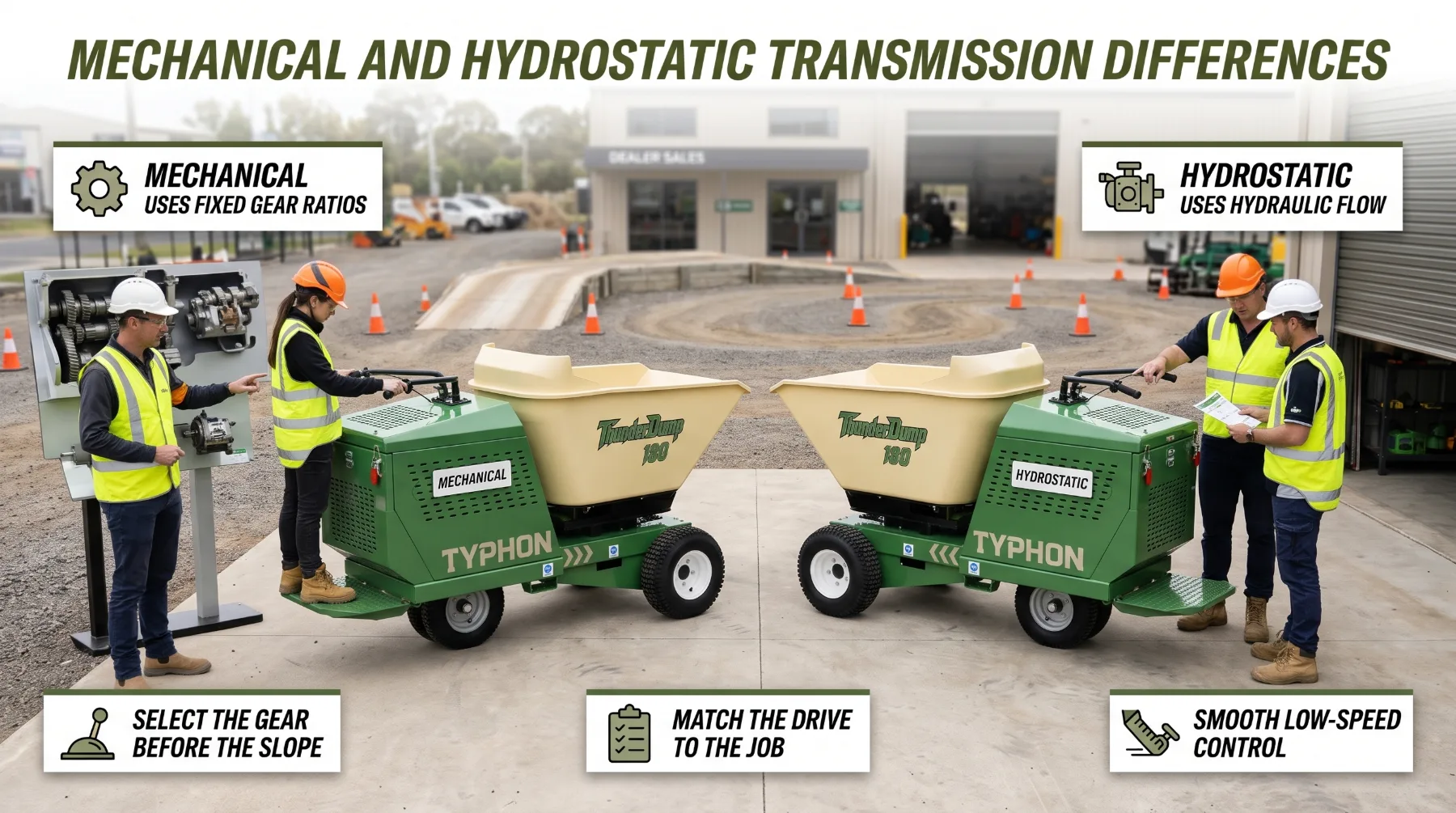
A mechanical transmission uses sets of gears to provide fixed ratios between engine speed and wheel speed. Low gears deliver high torque at low speed for pulling away, climbing, and working on soft ground, while higher gears provide more speed for longer travel. Many site dumpers with mechanical drive also include a clutch and shuttle or reverser, allowing operators to change direction without moving the main gear lever. This straightforward design is durable, familiar to many technicians, and provides direct control over gear selection.
However, mechanical transmissions require operators to select the correct gear according to the load, gradient, and ground conditions. Choosing too high a gear on a climb can stall the engine or strain the clutch, while changing gears during a descent can temporarily interrupt drive. These systems are often suitable for fleets that prioritize simple maintenance, familiar components, and longer, steadier hauling operations.
A hydrostatic transmission uses hydraulic power instead of conventional gears to drive the machine. An engine-driven variable-displacement pump sends pressurized oil to hydraulic motors, which drive the wheels or tracks. Wheeled dumpers commonly use a motor connected to the axles through a gearbox and drive shafts, while tracked models typically use a separate motor for each track. Operators control speed and direction through a pedal or lever, allowing smooth, continuously variable movement without clutch operation or manual gear changes. Hydrostatic drive provides precise low-speed control, smooth direction changes, and steady pulling power from a standstill. Many systems also offer low and high speed ranges for loaded work and faster travel.
Hydrostatic transmissions are particularly useful on confined sites, uneven ground, frequent reversing operations, and jobs requiring precise positioning. Easing off the travel pedal creates a strong slowing effect that helps control movement on descents, although it does not replace the service or parking brake. These systems also require careful attention to hydraulic oil cleanliness, temperature, and component condition. Ultimately, mechanical transmissions suit operators who value straightforward drivetrains and steady hauling, while hydrostatic systems offer greater flexibility and smoother control for demanding site conditions. The better choice depends on the dumper’s applications, maintenance resources, and operator experience.
Key takeaway: Mechanical transmissions use fixed gear ratios and require good gear selection, while hydrostatic transmissions use hydraulic flow for smooth, variable control, so choose the type that fits your routes, maintenance capability, and operators.
Travel Speed and Loaded Transport Performance
Specification sheets usually list a maximum travel speed. That figure is real, but it’s typically measured empty, in the highest gear or speed range, on a firm, level surface. Construction sites rarely offer those conditions for long. A loaded dumper on a rutted, narrow, or sloping route will rarely reach its top speed, and it shouldn’t try.
Loaded transport performance gives a far more useful picture. A full skip changes everything about how the machine behaves. Acceleration is slower, stopping distances are longer, and the raised mass of the load reacts to bumps, braking, and steering. A dumper that pulls strongly from a standstill and holds a steady, controlled speed on a grade with a full payload will usually finish more trips safely than one with a higher top speed but weak loaded performance.
Consider a crew hauling spoil 600 feet from a basement excavation to a stockpile. The route includes a ramp out of the dig, a tight turn past a scaffold, and a stretch of compacted haul road. Top speed matters only on the final straight section. Cycle time depends far more on how quickly the operator pulls away loaded, climbs the ramp without wheel spin, and maneuvers through the turn. On a short, tight route like this, smooth low-speed control often saves more time than extra top speed.
Site speed limits and conditions set the real ceiling. Follow your site traffic plan, and slow down further at corners, gateways, ramp crests, uneven ground, and areas with pedestrians or other plants. Keep a safe following distance, since a loaded machine needs more room to stop, especially downhill or on loose material. Make sure the load doesn’t block the forward view, which is one reason partial loads are often safer on busy or rough routes.
When comparing machines, ask for loaded and unloaded travel figures, speed ranges, and gradeability. Then test them on a route similar to your own. Remember that gradeability describes what a machine can climb, not what it can safely carry or stop on.
Key takeaway: Judge dumpers by loaded travel performance, including pull-away, grade holding, and low-speed control, rather than maximum speed, and keep travel within site limits and real ground conditions.
Traction and Drivetrain Performance on Uneven Ground
Power only moves a dumper when it reaches the ground. Mud, loose soil, wet clay, gravel, and slopes all reduce the grip available at the wheels or tracks. A drivetrain that delivers power smoothly and keeps all contact points working gives the operator more control and fewer stalls.
Drivetrain features that support traction
Four-wheel drive spreads tractive effort across all four wheels, which is why it’s standard on most site dumpers. Standard differentials let wheels turn at different speeds in corners, but they also allow a wheel with little grip to spin while the others stop pulling. Some dumpers use limited-slip differentials or selectable differential locks to send more drive to the wheels that still have grip. Use differential locks only as the manual instructs, usually when traveling straight on poor ground, and disengage them before turning.
An oscillating rear axle or chassis keeps wheels in contact with uneven ground, which helps maintain both traction and stability. Weight distribution matters as well. A loaded skip shifts weight toward the front on many forward-tip dumpers, which changes how grip is shared between axles.
Tires, tracks, and ground clearance
Tires and tracks are the final link in the drivetrain. Inspect tires for cuts, worn tread, embedded objects, and correct pressure, since underinflated tires flex, lean under load, and grip unpredictably. Mud packed into treads can make even aggressive tires behave like slicks. Tracked dumpers spread weight over a larger area and often perform better on soft ground, but tracks still slip on wet clay, steep grades, and loose material. Check track tension, lugs, and packed debris every shift.
Ground clearance determines whether the machine can cross ruts and spoil heaps without grounding the chassis or axles. A dumper that bottoms out loses traction instantly and risks damage to the drivetrain.
Driving technique and slope limits
Smooth inputs protect traction. Pull away gently, avoid sharp acceleration and harsh braking, and steer progressively, since sudden inputs break grip and shift the load. Select the correct gear or speed range before starting a climb or descent. On mechanical dumpers, never coast in neutral or change gear partway down a slope.
Follow the manufacturer’s slope limits for loaded and unloaded travel. Travel straight up and down slopes rather than across them, and avoid turning on inclines. For many loaded forward-tip dumpers, this means driving forward up a slope and reversing down so the heavy skip stays on the uphill side, but always confirm the direction for your model in the manual. Four-wheel drive, tracks, and differential locks improve traction. They don’t change the machine’s stability or braking limits. If the dumper begins to slide, avoid sharp corrections, stop when it’s safe to do so, and report the conditions before work continues.
Keep the roll-over protective structure raised and locked, and wear the seat belt whenever the frame is upright. Lower a folding ROPS only where the manufacturer permits it for a specific restricted-height task with additional controls in place. Most serious overturns become far more dangerous when the operator isn’t belted in.
Key takeaway: Four-wheel drive, differential control, oscillation, and well-maintained tires or tracks all support traction, but smooth driving, correct gear selection, and strict slope limits keep the dumper in control on uneven ground.
Transmission Cooling and Maintenance Requirements
Every transmission turns part of the engine’s power into heat. Heavy payloads, repeated climbs, soft ground, frequent direction changes, and hot weather all raise the heat load. Hydrostatic systems are particularly sensitive, because hydraulic oil that runs too hot thins out, leaks internally, and breaks down. Mechanical gearboxes and torque converters also suffer when oil overheats or runs low.
Keeping the cooling system working
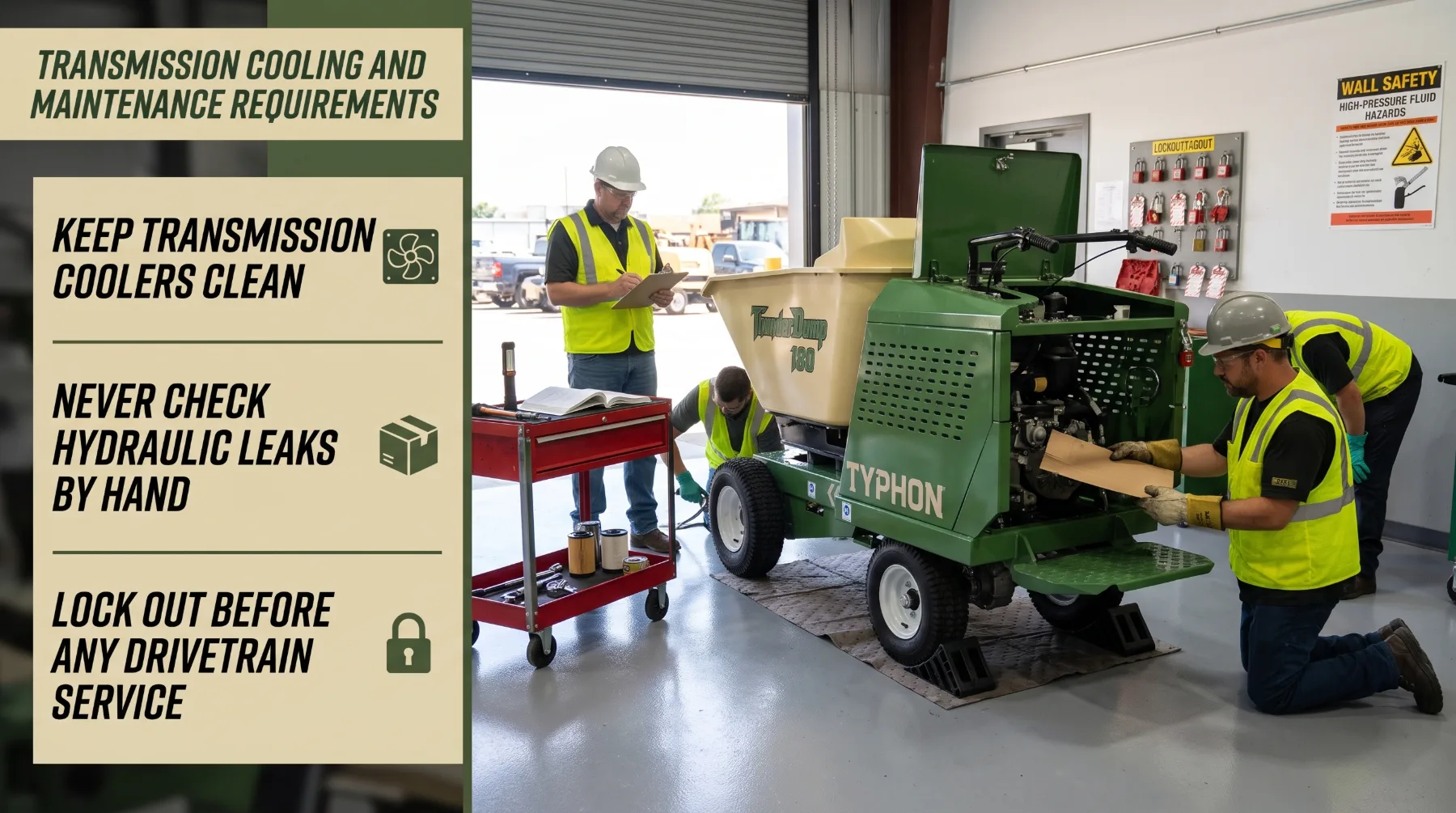
Many dumpers use an oil cooler for the transmission or hydrostatic circuit, often placed beside the engine radiator. Dust, mud, chaff, and spilled material can clog these cores and cut airflow sharply. Inspect and clean the screens and cores as the manual instructs, more often in dusty or muddy conditions. Clean only with the engine shut down and cooled. Use compressed air from the clean side of the core or low-pressure water, and avoid high-pressure washers that flatten fins.
Watch temperature gauges and warning lights throughout the shift. If transmission or hydraulic oil temperature climbs, stop work in a safe area, lower the skip, and follow the manufacturer’s procedure. Don’t keep pushing a machine that shows overheating warnings. Find the cause, whether it’s a clogged cooler, low oil, a slipping drive, or an overloaded skip.
Routine checks and service
Check transmission or hydrostatic oil levels at the intervals and machine positions the manual specifies. Use only the specified fluid type and grade, since the wrong fluid can damage clutches, seals, pumps, and motors. Keep fill points clean, replace filters and breathers on schedule, and look at the oil during service. Dark, burnt-smelling oil suggests overheating, while milky oil points to water contamination.
Inspect drive shafts, universal joints, the articulation area, axle seals, and hydraulic hoses for wear, leaks, and damage. Grease drive line and pivot points at the specified intervals. Listen for whining, grinding, clunking, or vibration, and note any slipping, hesitation, or loss of drive. Report these signs early. Small transmission problems become expensive quickly if the machine keeps working.
Safety during inspection and service
Never use your hand to search for a hydraulic leak. Fluid escaping through a pinhole under pressure can penetrate skin and cause an injection injury that needs immediate emergency medical treatment, even when the wound looks minor. Use a piece of cardboard or wood, and wear gloves and eye protection. Hot transmission and hydraulic oil can also cause burns, so let the system cool before opening fittings or fill points.
Before any inspection or repair, park on firm, level ground. Lower the skip, or secure it with the manufacturer’s approved body prop, and never work beneath a skip held only by hydraulic pressure. Apply the parking brake, shut down the engine, remove the key, apply your personal lock and tag, and relieve hydraulic pressure as the manufacturer instructs. Chock the wheels where required. If a hydrostatic dumper must be towed, follow the manual’s towing procedure, which may require releasing brakes or opening a bypass valve, since towing it incorrectly can damage the drive.
Key takeaway: Keep coolers clean, maintain the correct oil level and type, follow service intervals, report unusual noise or slipping early, check leaks with cardboard, and lock out the machine before any transmission service.
Conclusion
Dumper transmission systems shape how efficiently and safely material moves across a construction site. The transmission converts engine power into usable speed and torque. Mechanical and hydrostatic designs each deliver that power differently, with different demands on operators and maintenance teams. Loaded travel performance, not maximum speed, determines real cycle times. Traction depends on the drivetrain, tires or tracks, and smooth driving within strict slope limits. Clean coolers, correct fluids, and timely service keep the transmission dependable through long, hard shifts.
Frequently Asked Questions
What does a dumper transmission do?
The transmission transfers engine power to the drivetrain and controls how the dumper moves at different speeds and loads. It provides high torque at low speed for pulling away, climbing, and soft ground, and higher speed with less torque for easier travel. Power then passes through drive shafts, differentials, and final drives to the wheels, or through hydraulic motors to the tracks. Transmission design affects acceleration, grade performance, control, and slowing on descents.
What is the difference between mechanical and hydrostatic dumper transmissions?
Mechanical transmissions use fixed gear ratios, often with a clutch and shuttle, so the operator selects a suitable gear for the load and terrain. Hydrostatic transmissions use an engine-driven hydraulic pump and motors to control speed and direction smoothly without gear changes. Hydrostatic drive offers precise low-speed control and strong dynamic slowing, while mechanical drive offers a simple, durable design. The right choice depends on your routes, maintenance resources, and operators.
Does transmission type affect dumper performance on slopes?
Yes. Transmission response and torque delivery influence how a dumper climbs, holds speed, and slows on slopes. Hydrostatic drives provide smooth control and dynamic slowing, while mechanical drives require the correct gear to be selected before the slope. Safe operation still depends on the manufacturer’s slope limits, load distribution, travel direction, traction, and ground conditions. Never treat gradeability or transmission features as a safe working angle.
How often should a dumper transmission be serviced?
Follow the manufacturer’s maintenance schedule for oil checks, filter and breather changes, fluid replacement, and drivetrain inspections. Check oil levels and clean coolers as the manual instructs, often daily during the pre-use inspection. Severe conditions such as heavy dust, mud, high temperatures, or continuous loaded hauling may call for shorter intervals. Report unusual noise, slipping, or overheating promptly, and lock out the machine before any service.
americanminiexcavator.com Featured Equipment
Looking for top-performing heavy equipment, authentic attachments, and dependable jobsite power? Explore verified models backed by manufacturer warranty and nationwide delivery.