
Forklift Safety Lifting, Load Center, and Stability
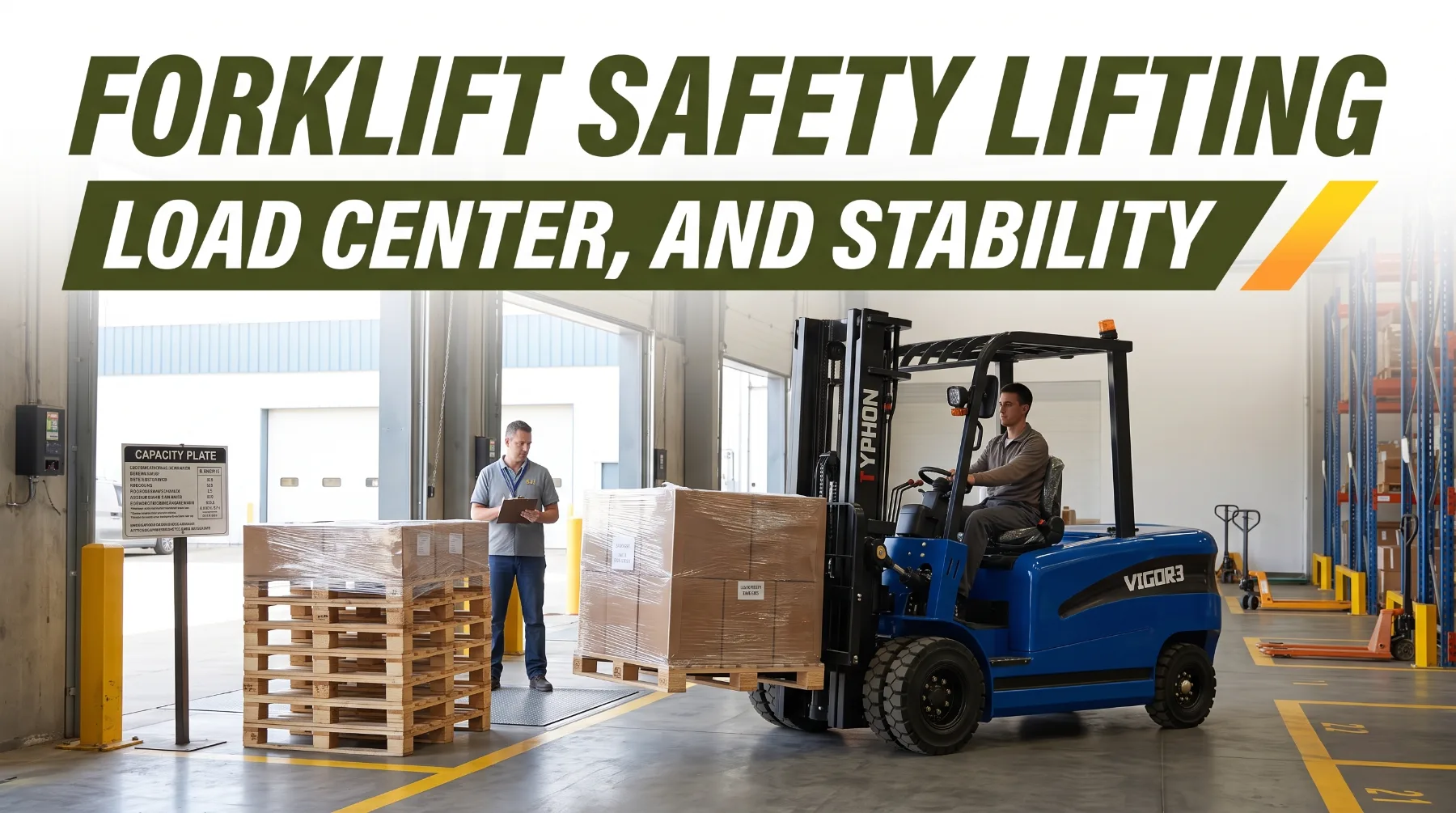
Before a forklift raises a pallet of boxed materials, the operator needs to consider more than whether the load looks stable. The position of the weight on the forks, the distance from the mast, and the planned lift height all affect how the truck responds once the load leaves the floor. A properly positioned pallet keeps the machine working within its designed stability limits, while an extended load center can place greater demand on the forklift and reduce its available lifting capacity.
Several factors determine how stable a lift remains throughout the cycle. Load center affects the leverage created by the weight, while rated capacity defines how much the forklift can safely handle at a specified configuration. Lift height, ground conditions, tire or equipment condition, and the way the load is secured can also change how the truck behaves during travel and placement.
Every lift begins with checking these conditions before the mast moves. Confirming the load weight, positioning the forks correctly, keeping the load close to the mast, and using suitable travel conditions all help maintain control. Regular inspection of tires, forks, mast components, and other equipment also supports stable operation from the first pallet of the shift to the last.
Understanding the Load Center
Load center is the horizontal distance from the fork face to the center of gravity of the load, and it’s one of the most important numbers in safe lifting. It describes how far the load’s weight reaches out from the mast, and that distance changes everything about how the load acts on the machine. A compact load sitting close to the mast behaves very differently from a long or deep load whose weight extends well out along the forks.
The reason this matters comes down to leverage. As the load center increases, the load creates greater leverage against the forklift, working to tip it forward around the front wheels. That growing leverage reduces the machine’s effective lifting capacity, meaning a forklift that comfortably handles a load at its rated load center may be overwhelmed by the same weight positioned farther out. Understanding load center is the foundation everything else in safe lifting builds on.
Key takeaway: Load center is the horizontal distance from the fork face to the load’s center of gravity, and a greater load center increases leverage against the forklift, reducing its effective capacity.
Keeping Loads Centered
How a load sits on the forks is just as important as how much it weighs and how it relates to the forklift’s load capacity. Loads should be positioned evenly across both forks and drawn back as close to the backrest as the application appropriately allows. A load balanced squarely across the forks and snug against the backrest keeps its center of gravity where the machine expects it, which supports predictable, controlled handling through the lift and the travel that follows.
Uneven positioning works against all of that. A load pushed to one side, resting on the fork tips, or stacked lopsided shifts its center of gravity away from the ideal position, making the load harder to handle and the machine less stable. That off-center weight can throw off the balance the forklift depends on, especially as the load rises and approaches the limits of its load capacity. Taking the extra few seconds to square up and seat the load properly is a small habit that pays off in steady, dependable handling.
Key takeaway: Position loads evenly across the forks and back against the backrest where appropriate, since uneven placement shifts the center of gravity and makes handling harder and less stable.
Following Rated Capacity
Every forklift carries a specified rated capacity, defined at a particular load center and lift height, and that figure sets the boundary for safe lifting. It isn’t a rough estimate or a starting suggestion. It’s the manufacturer’s statement of what the machine can safely handle under specific conditions, and it’s printed on the capacity plate for exactly that reason. Checking the plate before lifting an unfamiliar or heavy load should be automatic, not optional.
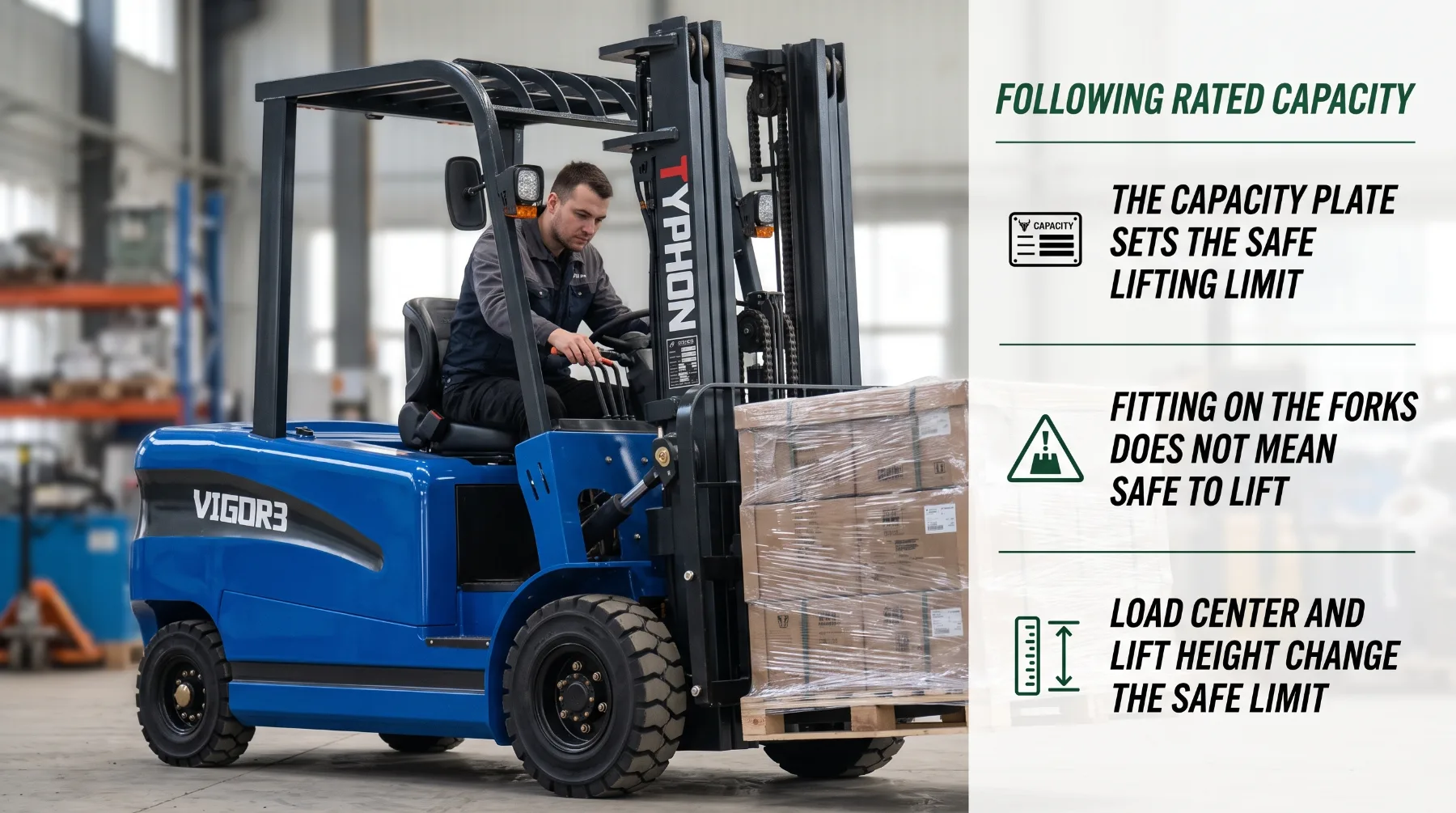
The trap many operators fall into is assuming that if a load fits on the forks, the machine can lift it. Fit and capacity are two entirely different things. A load can sit perfectly on the forks and still exceed what the forklift can safely raise, particularly once its load center or the intended lift height comes into play. Because rated capacity is tied to a defined load center and height, a load heavier than expected, positioned farther out, or lifted higher can push the machine past its safe limit. Read the plate, respect the number, and never let the fact that a load fits stand in for confirming the machine can handle it.
Key takeaway: Every forklift has a rated capacity at a defined load center and lift height, so check the capacity plate before lifting and never assume a load is safe just because it fits on the forks.
Managing Lift Height
Raising a load changes the forklift’s stability in real terms. As the load climbs, so does the combined center of gravity of the machine and its load, and a higher center of gravity makes the forklift more susceptible to tipping, particularly side to side. A load that feels perfectly stable near the floor becomes a very different proposition once it’s raised high on the mast, which is why height demands respect throughout the lift.
The practical response is straightforward. Loads should generally travel as low as practical while still keeping adequate ground clearance, so the center of gravity stays low and the machine stays stable as it moves. When the forks are elevated, avoid sudden movements: abrupt steering, braking, or acceleration with a raised load can upset the balance quickly and with little warning. Smooth, deliberate control and a low travel position are what keep an elevated load from turning into a stability problem.
Key takeaway: Raising a load lifts the combined center of gravity and reduces stability, so travel with loads as low as practical and avoid sudden movements when the forks are elevated.
Checking Ground Conditions
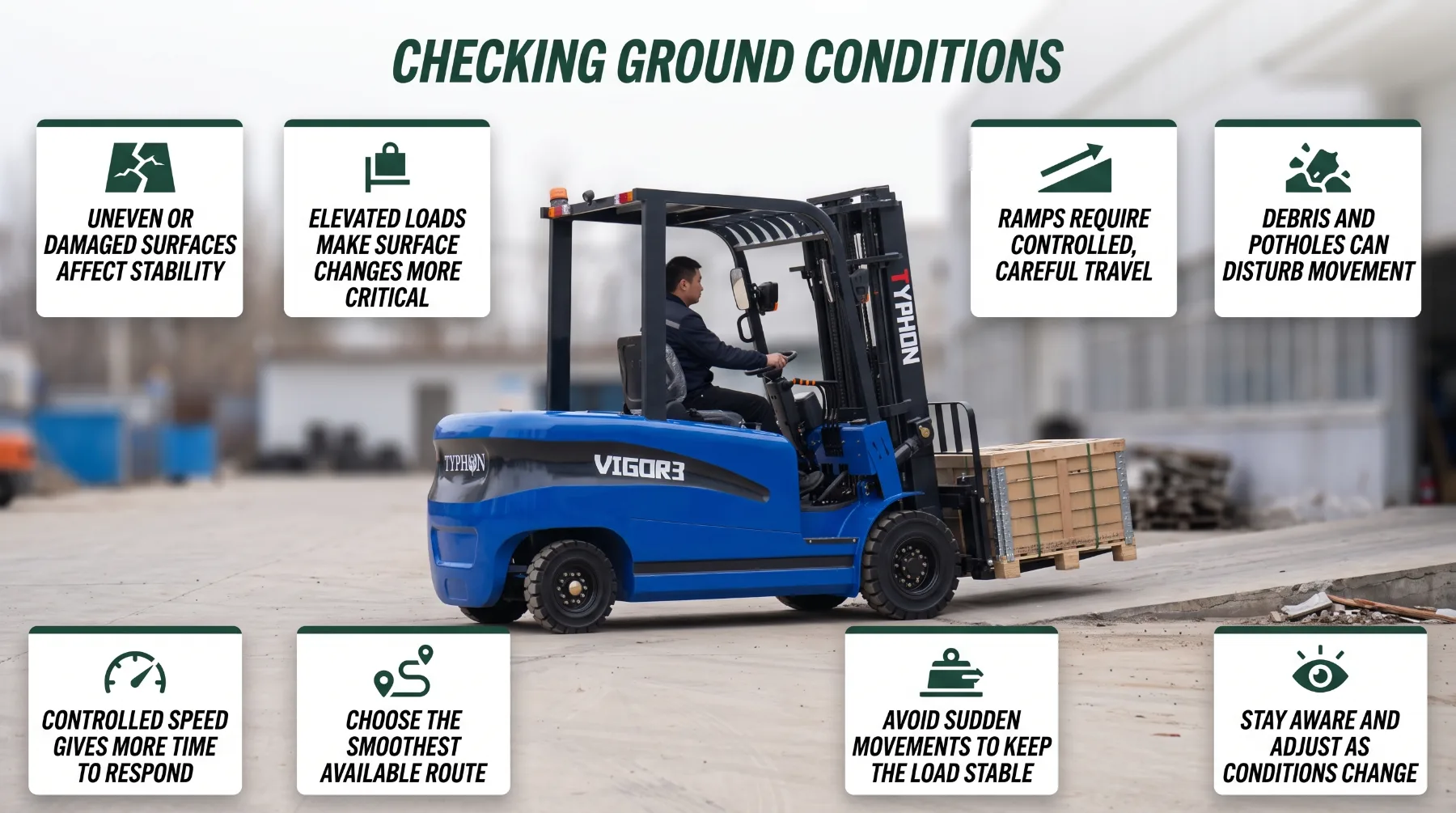
The surface a forklift operates on has a direct effect on machine stability and load handling. Uneven floors, ramps, potholes, dips, and debris can affect the forklift’s balance, especially when carrying a heavy or elevated load. A surface that feels manageable with an empty forklift can become much more challenging when the load is raised.
Operators should assess the travel surface before and during each movement and adjust their speed and path accordingly. Slowing down on ramps, rough areas, or sudden changes in elevation helps reduce unnecessary movement of the machine and load. Matching travel speed to the ground conditions supports more controlled handling.
- Surface Condition: Uneven or damaged surfaces can affect forklift stability.
- Load Position: Elevated or heavy loads can make surface changes more significant.
- Ramps: Slopes require controlled travel and careful load handling.
- Obstacles: Debris, potholes, and floor damage can disturb machine movement.
- Travel Speed: Controlled speeds give the operator more time to respond to changing surfaces.
- Path Selection: Choosing a smoother, more suitable route can help maintain stability.
- Load Control: Avoiding sudden movements helps keep the load more stable while traveling.
- Operator Awareness: Continuously reading the surface allows the operator to adjust speed and direction as conditions change.
Key takeaway: Uneven floors, ramps, potholes, and debris can disturb stability, especially under heavy or elevated loads, so travel at controlled speeds and account for surface conditions.
Maintaining the Forks and Mast
Safe lifting depends on equipment that’s in sound working order, which makes regular inspection of the lifting components essential. Forks, mast components, chains, hydraulic systems, and any attachments should all be checked routinely, because these are the parts that carry and control the load. When they’re in good condition, the forklift lifts predictably; when they’re worn or damaged, that reliability erodes in ways that can compromise both performance and safety.
Know what to watch for. Bent or cracked forks, worn or damaged mast components and chains, hydraulic leaks, and any visible damage to attachments all point to problems that can affect lifting performance and should be addressed before the machine goes to work. A hydraulic leak can cause a raised load to drift down, and worn or damaged forks can fail under load, so these aren’t issues to defer. Catching them during inspection means fixing them on your terms rather than discovering them mid-lift.
Key takeaway: Forks, mast components, chains, hydraulics, and attachments should be inspected regularly, since bent forks, worn parts, or hydraulic leaks affect lifting performance and must be addressed before operation.
Conclusion
Forklift stability depends on the relationship between machine weight, load weight, load center, lift height, and ground conditions because changes in any of these factors can affect the machine’s stability margin. Load center is the horizontal distance from the fork face to the load’s center of gravity, and a greater distance increases the overturning moment while reducing the effective capacity available for the load. Loads should be centered evenly across the forks and positioned against the backrest as permitted by the load and attachment configuration, while the capacity plate should always be checked before lifting because rated capacity varies with load center, lift height, attachment, and machine configuration. During travel, keeping the load as low as practical and avoiding sudden acceleration, braking, or turning helps maintain control, particularly on ramps, uneven floors, potholes, or debris-covered surfaces. Forks, mast components, lift chains, hydraulic circuits, and attachments should also be inspected regularly for damage, wear, leaks, or other conditions that could affect lifting performance. Evaluating load weight and position, machine capacity, lift height, travel path, surface conditions, and component condition together provides a more reliable basis for controlled forklift operation across warehouses, distribution centers, construction sites, and other material-handling environments.
Frequently Asked Questions
What is a forklift load center?
A forklift load center is the horizontal distance from the fork face to the load’s center of gravity. It shows how far the load’s weight sits from the mast along the forks. Forklift capacity ratings are based on a specified load center, so a load positioned farther out can reduce the machine’s effective lifting capacity.
Why does load center matter?
Load center affects the leverage a load places on the forklift. As the center of gravity moves farther from the fork face, the load creates greater forward leverage and reduces effective lifting capacity. Two loads with the same weight can therefore place different demands on the forklift depending on how their weight is distributed.
Should a forklift carry loads high while traveling?
No. Loads should be carried as low as practical while maintaining ground clearance and following the manufacturer’s requirements. A raised load increases the combined center of gravity and reduces stability. Keep loads low during travel and avoid sharp turns, sudden braking, or rapid acceleration when carrying a load.
What affects forklift stability?
Forklift stability depends on load weight, load center, lift height, surface conditions, travel speed, machine configuration, and operator actions. Uneven ground, ramps, turns, and excessive speed can further affect balance, especially with heavy or elevated loads. Proper load positioning and smooth operation help maintain stability.