
How Mini Excavators Improve Landscaping Efficiency
Landscaping is physically demanding work, and the margin between a profitable job and a losing one often comes down to how efficiently your crew moves material, shapes terrain, and finishes the site. For years, much of that work depended on shovels, wheelbarrows, and sheer manual labor, which is slow, exhausting, and difficult to scale. As projects grow more complex and clients expect faster turnarounds, that hand-powered approach quietly caps how many jobs a crew can complete in a season. The mini excavator changes that equation in a way few other machines can.
Compact, powerful, and remarkably versatile, the mini excavator has become one of the most valuable tools on a modern landscaping site. It digs, trenches, grades, lifts, and powers a wide range of attachments, all while fitting into spaces that larger equipment simply cannot reach. This guide is written for landscapers, landscape contractors, hardscape crews, property developers, and small construction business owners who want to get more done with less strain. We will explore how compact size, digging and trenching speed, grading preparation, material handling, attachment versatility, and easy transport combine to improve efficiency, protect finished surfaces, and help your business take on more work. By the end, you will see exactly how the right machine pays for itself in saved labor and stronger profitability.
Compact Size That Reaches Where Other Machines Can’t
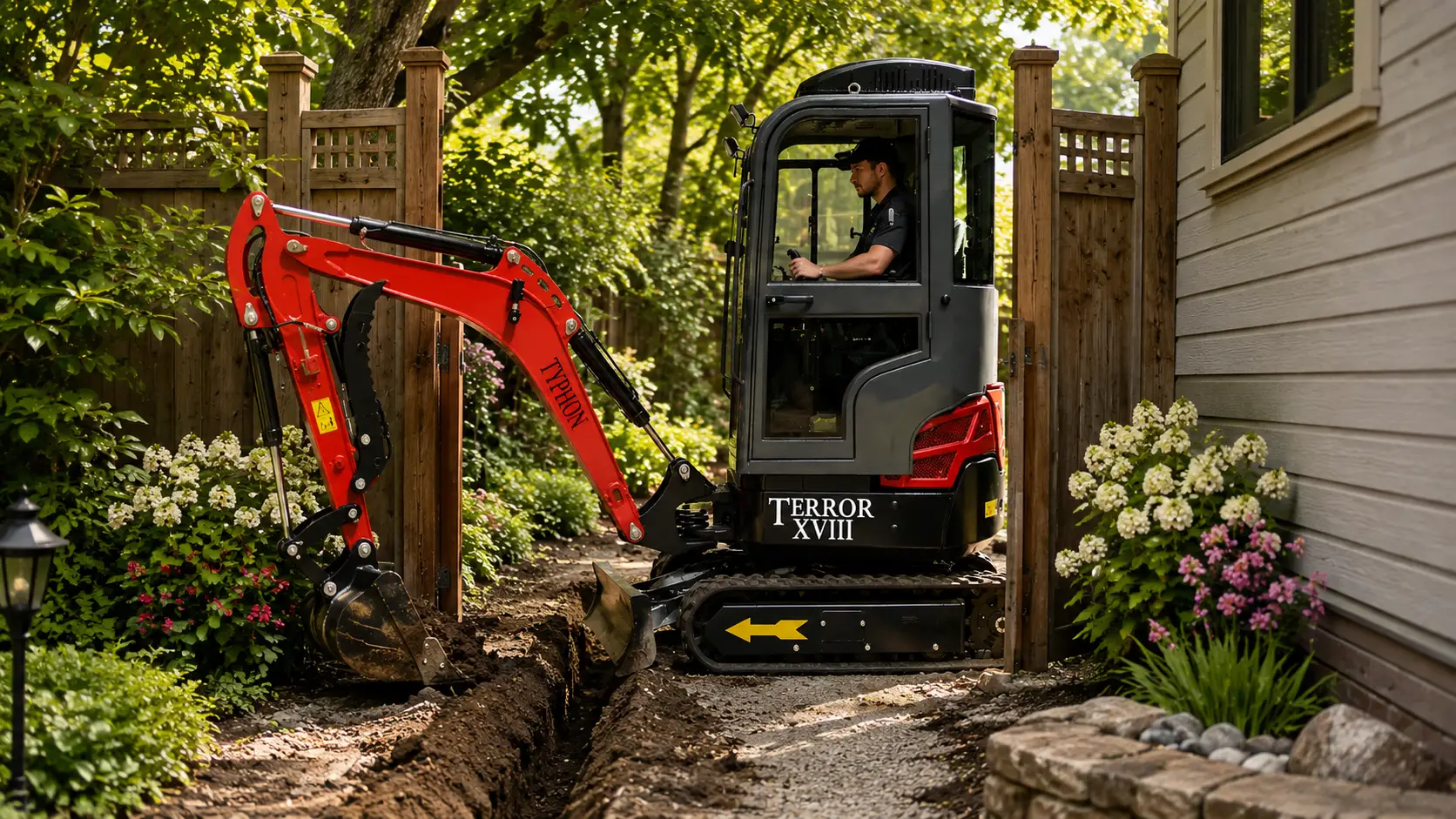
Landscaping projects rarely happen on wide-open ground. Most take place in fenced backyards, between established structures, along narrow side yards, and around mature trees, patios, and existing plantings. These confined conditions are exactly where larger equipment fails. A full-size excavator or skid steer often cannot fit through a standard gate, maneuver around a pool, or work close to a foundation without risking damage. When that happens, crews are forced back to hand labor, and the entire pace of the job slows to a crawl.
This is the core problem the mini excavator solves so effectively. Its compact chassis, narrow track width, and tight turning ability let it slip through gates, navigate around obstacles, and operate in spaces measured in inches rather than feet. Many models offer expandable undercarriages that retract to pass through tight openings and then widen for stability once the machine is in position. This means your crew can bring real mechanical power directly to the work area instead of digging by hand simply because nothing else fits.
The business impact here is immediate and significant. Work that once took a crew of laborers an entire day can often be completed in a fraction of the time by a single operator. You reduce physical strain, lower the risk of injury, and free your team to focus on skilled finishing tasks rather than brute-force digging. Access, in short, becomes a competitive advantage. Once the machine reaches the work area, its real strength shows up in how quickly it moves earth.
Digging and Trenching Speed That Transforms Timelines
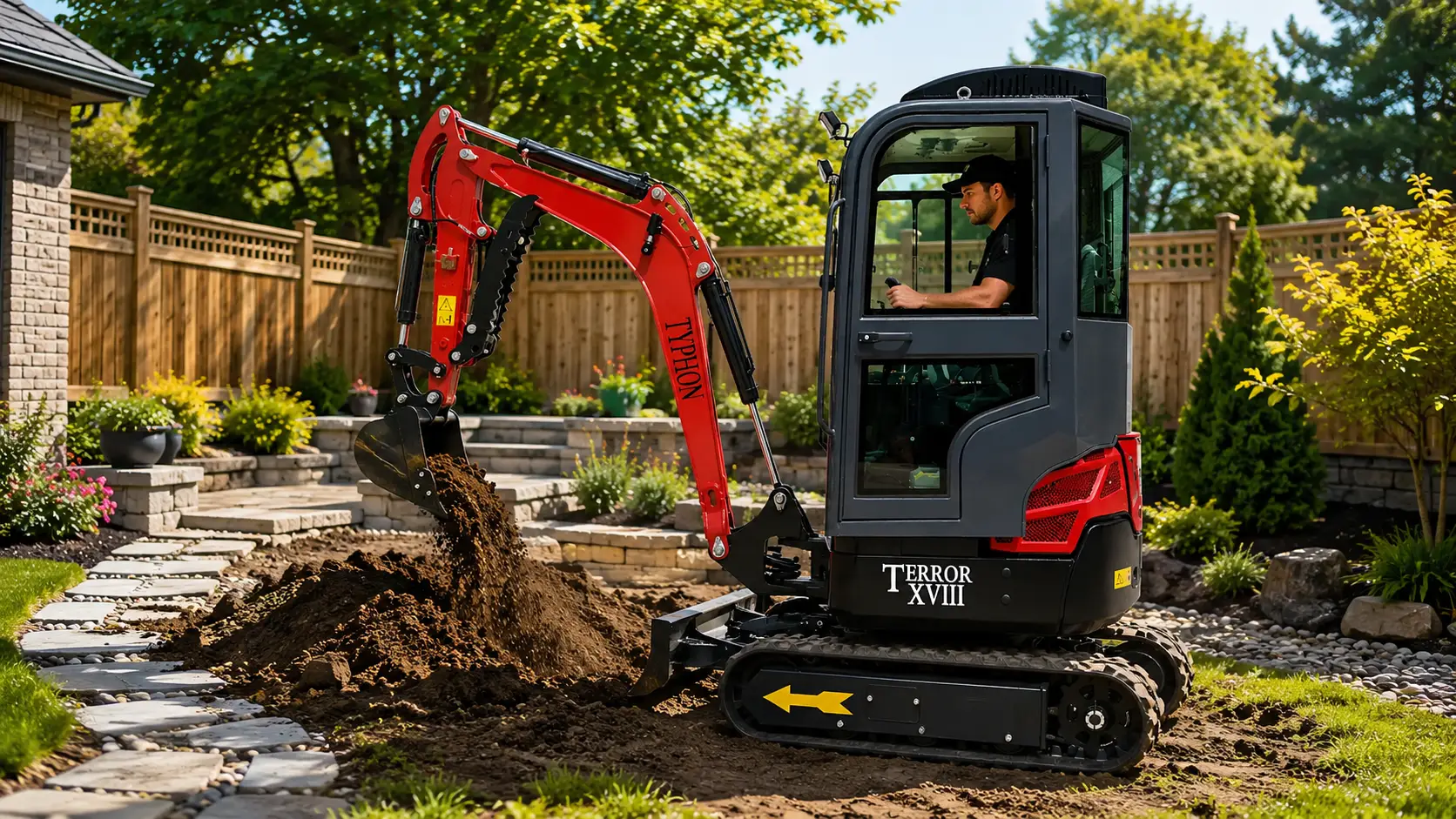
Digging is at the heart of most landscaping projects, whether you are installing irrigation lines, setting footings for a retaining wall, planting large trees, or running drainage. Done by hand, this work is brutally slow and inconsistent. A crew can spend hours trenching a single run, and fatigue inevitably leads to uneven depths, ragged edges, and the kind of rework that quietly eats your margins. The labor cost alone can make smaller jobs barely worth taking.
A mini excavator attacks this bottleneck directly. With strong hydraulic digging force and precise boom control, an operator can cut clean, consistent trenches far faster than any hand crew, holding a steady depth and line across the entire run. Whether you are installing a drainage system, burying utility lines, or excavating for a pond or water feature, the machine delivers repeatable results that hand digging cannot match. The bucket does in minutes what a shovel does in hours, and it does it without wearing out your people.
The real-world payoff lands squarely on your bottom line. Faster digging compresses project timelines, which means you complete jobs sooner and move to the next one with less downtime. Consistent trench depth and clean edges reduce rework and produce a more professional result that clients notice. Most importantly, you slash the labor hours tied up in the most exhausting part of the job, turning marginal projects into profitable ones. With the heavy digging handled, the next phase of any quality landscape is shaping the ground itself.
Precise Grading and Site Preparation
Grading is where a landscape project either comes together or falls apart. Proper slope and a level, well-compacted base are essential for patios, walkways, lawns, drainage, and nearly every hardscape feature. Get the grade wrong, and you invite pooling water, settling pavers, and callbacks that damage both your reputation and your profit. Traditional grading by rake and shovel is not only slow but also difficult to keep accurate across a large area.
A mini excavator brings real control to this critical stage. Using the blade, bucket, and smooth hydraulic movements, an operator can spread soil, cut high spots, fill low areas, and establish consistent slopes with a precision that hand grading struggles to achieve. Many machines pair well with grading attachments and can be guided by laser or modern grade-control systems for even tighter accuracy. This lets you prepare a clean, properly sloped base that sets up every downstream task for success.
The benefit to your operation is twofold. First, you finish site preparation faster and with far less manual effort, which keeps labor costs down and your crew fresh for skilled work. Second, accurate grading directly improves finish quality, reducing the drainage problems and surface failures that lead to expensive callbacks. A well-prepared base protects everything built on top of it, and that reliability builds the kind of client trust that generates referrals. Beyond shaping the ground, the machine also takes over one of the most physically punishing parts of the job.
Material Handling That Saves Backs and Hours
Few tasks drain a landscaping crew faster than moving heavy material by hand. Soil, gravel, mulch, sod, boulders, retaining wall blocks, and pavers all have to be transported, positioned, and placed, often across uneven terrain and tight spaces. Done with wheelbarrows and muscle, this work is slow, exhausting, and a leading cause of crew injuries. The physical toll also limits how long a team can stay productive over the course of a long day.
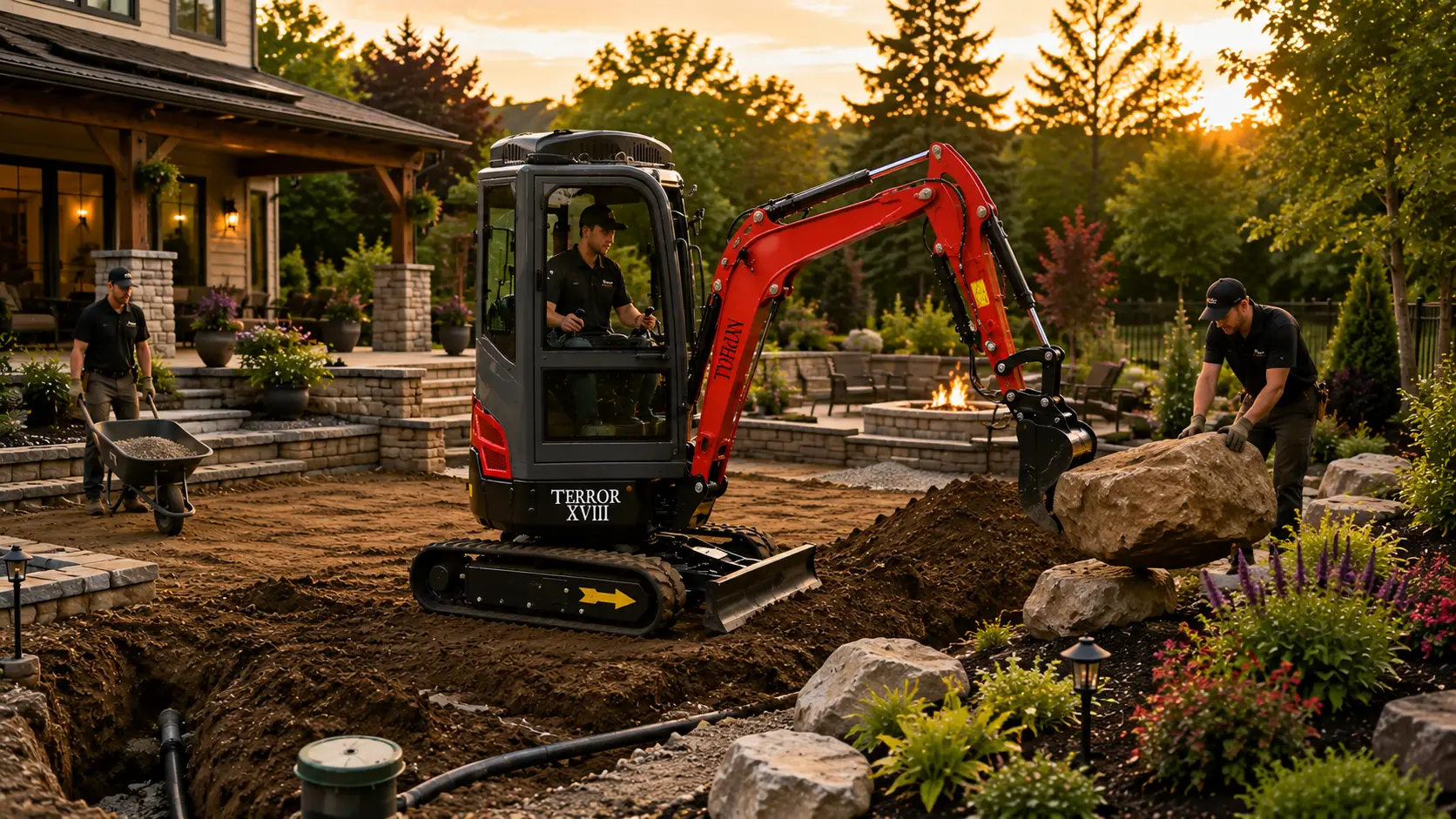
A mini excavator transforms material handling into a far more manageable task. With the right attachments, it can lift and carry boulders, set heavy blocks, distribute gravel, and move pallets of material directly to where they are needed. A hydraulic thumb, for example, gives the machine the ability to grip and place irregular objects like rocks and timbers with control and precision. Instead of three workers wrestling a single boulder into place, one operator can position it exactly where it belongs in a fraction of the time.
The impact on efficiency and safety is hard to overstate. Reducing manual lifting protects your crew from the strains and injuries that drive up insurance costs and sideline experienced workers. Faster material movement keeps the entire project flowing, so your team spends time on craftsmanship rather than hauling. You also gain the ability to take on heavier, more ambitious hardscape and boulder work that would be impractical by hand. This kind of flexibility points to one of the machine’s greatest strengths: its ability to adapt to many jobs through attachments.
Attachment Versatility That Multiplies What One Machine Can Do
A mini excavator’s true value extends far beyond the standard bucket. The same machine that digs a trench in the morning can break concrete, drill post holes, grind stumps, or compact soil in the afternoon, simply by switching attachments. For a landscaping business, this versatility is the difference between owning a single-purpose tool and owning a complete, adaptable work system that handles a remarkable range of tasks.
The limitation many crews face is relying on separate tools, rentals, or subcontractors for each specialized job. That fragmented approach wastes time, adds cost, and complicates scheduling. A mini excavator with strong auxiliary hydraulics solves this by powering a deep catalog of attachments. Augers make quick work of planting trees and setting fence posts. Hydraulic breakers handle demolition of old concrete and stone. Grapples and thumbs manage brush, logs, and rock. Compaction plates firm up trenches and bases. Each attachment expands the range of work you can perform with one machine.
Here is the practical advice: when evaluating a machine, confirm its auxiliary hydraulic flow and pressure, and choose a quick coupler so operators can swap attachments in seconds rather than minutes. The business payoff is substantial. Every additional capability is another service you can bid on and another revenue stream you can capture without buying a second machine or hiring out the work. This versatility lets a small crew compete for larger, more diverse projects and keeps the machine earning across the entire season. Of course, all of this capability only matters if you can move the machine easily from site to site.
Easy Transport and Reduced Lawn Damage
A machine that is difficult to transport or that tears up the very landscapes you are paid to improve creates problems that cancel out its benefits. Landscaping crews move between jobsites constantly, sometimes hitting several properties in a single day. If hauling the equipment is a major undertaking, or if the machine damages finished lawns and driveways on arrival, the efficiency gains quickly disappear under added cost and client frustration.
Mini excavators are built with both of these concerns in mind. Their compact size and modest weight mean most models can be towed on a standard trailer behind a capable truck, without the need for specialized hauling or commercial transport. This lets a crew load up, move to the next property, and be working again with minimal delay. Just as importantly, most mini excavators run on rubber tracks that distribute the machine’s weight gently across the ground. This protects established lawns, sod, driveways, and finished surfaces far better than wheeled equipment or steel tracks.
The combined effect supports both efficiency and reputation. Easy transport means more jobs per day and lower hauling expenses, while gentle ground pressure means you can work across a client’s property without leaving the ruts and damage that lead to costly repairs and unhappy customers. Protecting finished surfaces is not a minor detail; it directly affects whether a client recommends you to others. When transport is simple and the machine treats the site with care, your crew can take on more work and deliver it cleanly, which is the foundation of a more profitable business.
Conclusion
Mini excavators improve landscaping efficiency by attacking the biggest drains on a crew’s time and energy all at once. Their compact size reaches confined spaces other machines cannot, their digging and trenching speed compresses timelines, and their grading precision sets up clean, reliable finishes. Add in faster material handling, broad attachment versatility, easy transport, and gentle treatment of finished surfaces, and you have a single machine that reduces labor, protects your crew, and expands the range of jobs you can confidently take on.
For landscapers, landscape contractors, hardscape crews, property developers, and small business owners, the next step is to look honestly at where your projects lose the most time and money. If hand digging, material hauling, and slow site prep are eating your margins, a mini excavator is one of the most direct ways to fix it. Match the machine size to your typical jobsites, confirm the hydraulic capacity for the attachments you need, and verify you can transport it easily. Make that choice with care, and the right mini excavator will repay you with faster jobs, healthier crews, and stronger profitability season after season.